How much should I put aside for tax if I'm self-employed?
Sole traders should set aside about 15% of profit at £30,000 and 20% at £50,000 in 2026/27, more in the first year of payments on account. Directors' figures too.
Most sole traders should set aside about 15% of their profit for tax at £30,000 a year, and about 20% at £50,000, in 2026/27. In the year before your first payments on account, put aside about one and a half times that, because January brings last year's bill and half of it again.
The figures below come from HMRC's 2026/27 rates for England, Wales and Northern Ireland. There is a Scottish note further down, and a section for directors who pay themselves in dividends.
Why the percentage changes with profit
As a sole trader you pay two things on your profit through Self Assessment:
- Income Tax: nothing on the first £12,570 (your Personal Allowance), then 20% up to £50,270, then 40%
- Class 4 National Insurance: 6% on profits from £12,570 to £50,270, then 2% above
If your profit is £7,105 or more, Class 2 National Insurance is treated as paid, so there is nothing extra to put by for it.
So each extra pound of profit costs 26p between £12,570 and £50,270 (20% plus 6%), and 42p between £50,270 and £100,000 (40% plus 2%). Above £100,000 your Personal Allowance starts to shrink, so the rate rises again. The tax-free first £12,570 is why your overall percentage is always lower than these rates.
Not sure which way to work? Our guide to sole trader or limited company compares the two, and salary vs dividends covers the company side.
Sole traders: how much to set aside in 2026/27
| Profit | Income Tax | Class 4 NI | Total tax | Share of profit | Set aside |
|---|---|---|---|---|---|
| £20,000 | £1,486 | £446 | £1,932 | 9.7% | 10% |
| £30,000 | £3,486 | £1,046 | £4,532 | 15.1% | 15% |
| £50,000 | £7,486 | £2,246 | £9,732 | 19.5% | 20% |
| £80,000 | £19,432 | £2,857 | £22,289 | 27.9% | 28% |
Figures are rounded to the nearest pound and assume no other income.
Worked example
Sam is a sole trader expecting £50,000 profit in 2026/27.
- Taxable profit: £50,000 minus £12,570 = £37,430
- Income Tax at 20%: £7,486
- Class 4 NI at 6%: £2,245.80
- Total: £9,731.80, or 19.5% of profit
Sam moves 20% of each month's profit into a separate savings pot. If one month brings £5,000 of sales and £1,000 of costs, that is £800 put aside. You can try your own figures in the sole trader take-home calculator.
Profit is income minus allowable expenses. If you are unsure what counts, see what expenses can I claim as a sole trader. If your side income is small, the £1,000 trading allowance may mean there is nothing to save at all.
The second-year jump: payments on account
Once your Self Assessment bill is £1,000 or more (and less than 80% of your tax is paid through PAYE), HMRC asks for payments on account. These are two advance payments towards next year's bill, each half of last year's, due on 31 January and 31 July.
The first time it happens, January carries two things at once. For Sam:
| Due 31 January | Amount |
|---|---|
| Bill for the year just ended | £9,732 |
| First payment on account for this year (half) | £4,866 |
| Total | £14,598 |
That is 29% of one year's profit, due in one go. Then another £4,866 is due on 31 July.
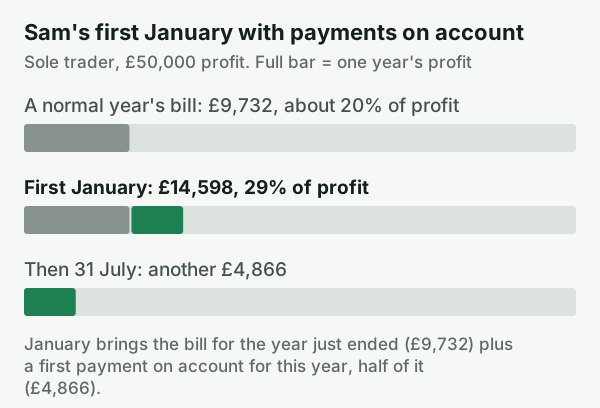
So in the year before your first payments on account, aim to set aside about one and a half times the table figure: 30% instead of 20% at £50,000 profit, or about 23% instead of 15% at £30,000. From then on, January and July each take roughly half a year's bill, and the table percentage keeps you level. Our guide to payments on account explained walks through the dates.
Directors taking dividends
Many directors of one-person companies take a £12,570 salary and the rest as dividends. The salary uses your Personal Allowance and goes through payroll. The tax to set aside is on the dividends.
In 2026/27 you get a £500 dividend allowance, then pay 10.75% in the basic rate band and 35.75% in the higher rate band. With a £12,570 salary, the basic rate band runs out at £37,700 of dividends (£50,270 of total income).
| Dividends (with £12,570 salary) | Dividend tax 2026/27 | Share of dividends | Set aside |
|---|---|---|---|
| £20,000 | £2,096 | 10.5% | 11% |
| £37,700 | £3,999 | 10.6% | 11% |
| £60,000 | £11,971 | 20.0% | 20% |
A simple rule: put aside 11% of each dividend until your total income reaches £50,270, then 35.75% of every dividend above that.
For the return due on 31 January 2027, the 2025/26 rates apply: 8.75% and 33.75%. On the same dividends that comes to £1,706, £3,255 and £10,781.
The same payments on account rules apply to directors. With no tax taken through PAYE on a £12,570 salary, a dividend tax bill of £1,000 or more brings them in.
The company has its own pot
Corporation tax is paid by the company on its profits, before dividends. It is 19% on profits of £50,000 or less, and 25% on profits over £250,000, with marginal relief in between. Keep that money in the company. Your personal set-aside is only for the tax on what you take out.
If you live in Scotland
Scottish taxpayers pay different Income Tax rates on salary and profits. National Insurance and dividend tax are the same as the rest of the UK. GOV.UK says you pay the same tax as the rest of the UK on dividends, so the director figures above do not change.
For sole traders in 2026/27, the Scottish bands are 19% from £12,571 to £16,537, 20% to £29,526, 21% to £43,662, 42% to £75,000, 45% to £125,140 and 48% above.
| Profit | Total tax (Scotland) | Share of profit | Rest of UK |
|---|---|---|---|
| £20,000 | £1,892 | 9.5% | 9.7% |
| £30,000 | £4,497 | 15.0% | 15.1% |
| £50,000 | £11,228 | 22.5% | 19.5% |
| £80,000 | £24,589 | 30.7% | 27.9% |
Below about £30,000 the set-aside is almost the same. Above it, Scottish sole traders should put aside 2 to 3 percentage points more.
How Holdfast helps
Holdfast works out your tax from your own books as you go and shows a live set-aside figure, including payments on account, Scottish rates and dividend tax for directors. It tracks HMRC deadlines with reminders, so the January and July amounts are ready before they are due. The payments on account help article explains how Holdfast works them out.
Questions
Is 30% the right amount to save for tax?
For most sole traders it is more than one year's bill needs. In 2026/27 the bill is about 15% of profit at £30,000 and about 20% at £50,000. But 30% is close to what you need for your first January with payments on account, when you pay last year's bill plus half of it again.
Should I save a percentage of my income or my profit?
Your profit. Tax is worked out on what is left after allowable expenses. If you find it easier, take the percentage of what comes in, which builds a small cushion.
How much should a director put aside from dividends?
With a £12,570 salary, about 11% of dividends while your total income stays under £50,270 in 2026/27, and 35.75% of every pound of dividends above that. The company's corporation tax is a separate pot.
Sources
- www.gov.uk/government/publications/rates-and-allowances-income-tax/income-tax-rates-and-allowances-current-and-past
- www.gov.uk/government/publications/rates-and-allowances-national-insurance-contributions/rates-and-allowances-national-insurance-contributions
- www.gov.uk/self-employed-national-insurance-rates
- www.gov.uk/tax-on-dividends
- www.gov.uk/scottish-income-tax
- www.gov.uk/understand-self-assessment-bill/payments-on-account
- www.gov.uk/self-assessment-tax-returns/deadlines
- www.gov.uk/corporation-tax-rates
This guide is general information, not financial, tax or legal advice. Tax rules change, so check GOV.UK or ask HMRC if you're unsure. Read our terms.
Try it and read more
- Sole trader take-home pay calculator 2026/27Free calculator
- Payments on accountPayments on account are advance payments towards your next Self Assessment bill, due on 31 January and 31 July.
- Income Tax and National Insurance ratesThe 2026/27 Income Tax bands and self-employed National Insurance rates, with worked examples and how Holdfast works out your bill.
- Your HMRC planThe HMRC plan shows everything you owe HMRC, when each bill is due, what you've paid and what to set aside.
More pay yourself guides
- Company car benefit in kind: how it's taxed in 2026/27Company car benefit is the list price times a CO2-based percentage: 4% for electric cars in 2026/27, rising to 9% by 2029/30. The company pays 15% Class 1A.
- Director pension contributions through your companyYour company can pay into your pension as a business cost, with no Income Tax or NI for you, up to the £60,000 annual allowance plus 3 years' unused allowance.
- Dividend tax rates and allowance for 2026/27In 2026/27 the first £500 of dividends is tax-free, then dividends are taxed at 10.75%, 35.75% or 39.35% depending on your band. See worked examples.
- Employment Allowance for sole director companiesEmployment Allowance cuts employer's NI by up to £10,500 in 2026/27, but not if your only director is the only employee paid over the £5,000 threshold.