What expenses can I claim as a sole trader?
Sole traders can claim business costs and the business share of mixed costs like a phone. See what counts, what doesn't and the 2026/27 flat rates.
As a sole trader you can claim costs you pay for running your business, and the business share of things you also use personally, like your phone or home. You cannot claim personal spending, everyday clothes, client entertaining or travel between home and a regular place of work.
Each allowable expense comes off your profit before tax. At basic rate, £100 of expenses saves you £26 (20% Income Tax plus 6% Class 4 National Insurance). Our guide to how much tax you pay as a sole trader shows how the rates work.
The basic rule
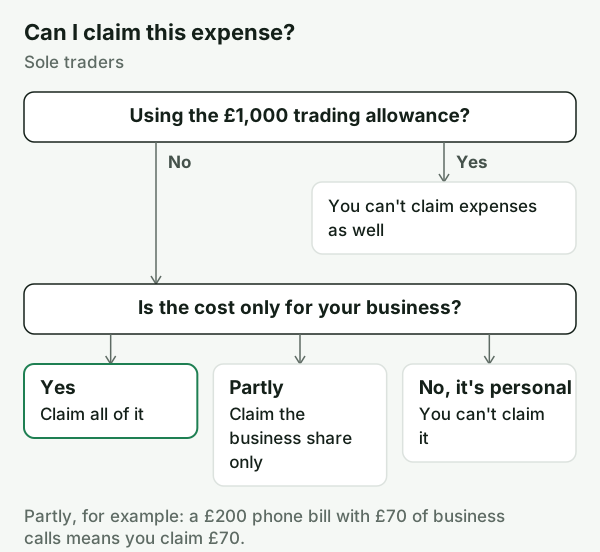
You can claim a cost if it is for your business. If something is used for both business and personal life, you claim only the business part.
GOV.UK's own example: your phone bill is £200 and £70 of it is business calls. You can claim £70.
Money you take out of the business for yourself is never an expense.
What you can claim
Office, phone and equipment
- Stationery, printer ink, postage and other things you use up within 2 years
- Phone, mobile and internet bills (business share)
- Business software and subscriptions
- Computers, printers and other equipment
Under cash basis, the standard way sole traders keep their books, you claim equipment as a normal expense. If you use traditional accounting instead, you claim it through capital allowances.
Working from home
You can claim a share of your heating, electricity and internet, worked out in a reasonable way, such as by the number of rooms or the time you spend working.
Or you can use a flat rate if you work at least 25 hours a month from home:
| Hours worked at home each month | Flat rate per month |
|---|---|
| 25 to 50 | £10 |
| 51 to 100 | £18 |
| 101 or more | £26 |
The flat rate does not cover phone or internet. You can still claim the business share of those on top.
Travel and vehicles
- Train, bus, tram, air and taxi fares for business trips
- Hotel rooms and meals on overnight business trips
- Fuel, parking and hire charges for business journeys
For a car or van you can claim the business share of the actual running costs, or use simplified expenses at a flat rate per business mile:
| Vehicle | 2026/27 | Before 6 April 2026 |
|---|---|---|
| Cars and goods vehicles, first 10,000 miles | 55p | 45p |
| Cars and goods vehicles, after 10,000 miles | 25p | 25p |
| Motorcycles | 24p | 24p |
You cannot use the mileage rates for a vehicle you have already claimed capital allowances on. From 6 April 2027 the rate after 10,000 miles is due to rise to 35p, as announced at the Budget on 28 October 2026.
Other common costs
- Stock or materials you buy to sell or use in your work
- Rent, business rates and utility bills for business premises
- Advertising, website costs and mailshots
- Trade or professional journals and subscriptions
- Bank, overdraft and credit card charges, and interest on business loans (not the loan repayments)
- Business insurance, such as public liability
- Accountants' and solicitors' fees for business reasons (not the cost of preparing your Self Assessment return)
- Staff costs
- Training that improves skills you already use in your business, or keeps you up to date in your industry
What you can't claim
| Cost | Why not |
|---|---|
| Everyday clothes (suits, shirts, dresses, ordinary shoes) | Not allowed even if you only wear them for work |
| Travel between home and your regular workplace | Not allowed |
| Fines and penalty charges | Specifically excluded |
| Entertaining clients, suppliers or customers | Includes meals and event tickets |
| Training to start a new business or move into an unrelated area | Not linked to your current trade |
| Personal share of mixed costs | Only the business part counts |
You can claim promotional gifts that carry your business name, like diaries or keyrings, up to £50 per person per tax year. Gifts of food, drink or tobacco are not allowed.
Worked example
Tom is a self-employed graphic designer. His sales for 2026/27 are £40,000. His allowable expenses are:
- Design software: £600
- Phone: £600 a year, half for business, so £300
- Working from home over 101 hours a month: £26 x 12 = £312
- 2,000 business miles in his own car at 55p: £1,100
- A new laptop (cash basis): £1,200
His expenses total £3,512, so his profit is £36,488.
Without those claims he would pay tax on the full £40,000. Claiming them cuts his Income Tax by £702.40 and his Class 4 by £210.72. That is £913.12 less tax.
See what your own profit leaves you with in the sole trader take-home calculator.
Expenses or the trading allowance?
You can choose the £1,000 trading allowance instead of claiming expenses. You cannot have both. If your costs are more than £1,000, claiming them usually saves more. Our guide to the £1,000 trading allowance explains when the allowance wins.
Keep the proof
You don't send receipts with your tax return, but HMRC can ask for them. Keep records of every expense for at least 5 years after the 31 January deadline for that tax year. For 2026/27, the deadline is 31 January 2028, so keep the records until at least the end of January 2033.
Your expenses also shape how big your bill is, which matters when you work out how much to put aside for tax when self employed.
How Holdfast helps
Keeper, Holdfast's assistant, sorts your payments into the right expense categories as they come in, and you can snap receipts, log mileage at HMRC's rates and connect your bank so payments arrive by themselves. Your expenses flow straight into the SA103 self-employment pages, worked out box by box for you to copy into HMRC's online return. The allowable expenses help article shows how to check and correct a category.
Questions
Can I claim my phone if I'm self employed?
You can claim the business share. If your bill is £200 and £70 of it is business calls, you claim £70.
Can I claim clothes I wear for work?
Only protective clothing, uniforms, specialist outfits or costumes. Everyday clothes such as suits, shirts, dresses or ordinary shoes are not allowed, even if you only wear them for work.
Can I claim expenses and the £1,000 trading allowance?
No. It is one or the other. If your expenses are more than £1,000, claiming them saves you more tax.
Sources
- www.gov.uk/expenses-if-youre-self-employed
- www.gov.uk/expenses-if-youre-self-employed/office-property
- www.gov.uk/expenses-if-youre-self-employed/travel
- www.gov.uk/expenses-if-youre-self-employed/clothing
- www.gov.uk/expenses-if-youre-self-employed/marketing-entertainment-subscriptions
- www.gov.uk/expenses-if-youre-self-employed/training-courses
- www.gov.uk/expenses-if-youre-self-employed/legal-financial
- www.gov.uk/simpler-income-tax-simplified-expenses/vehicles
- www.gov.uk/simpler-income-tax-simplified-expenses/working-from-home
- www.gov.uk/simpler-income-tax-cash-basis
- www.gov.uk/self-employed-records/how-long-to-keep-your-records
- www.gov.uk/government/publications/budget-2026-overview-of-tax-legislation-and-rates-ootlar/budget-2026-overview-of-tax-legislation-and-rates-ootlar
This guide is general information, not financial, tax or legal advice. Tax rules change, so check GOV.UK or ask HMRC if you're unsure. Read our terms.
Try it and read more
- Sole trader take-home pay calculator 2026/27Free calculator
- Allowable expenses for the self-employedWhat business costs you can claim to lower your tax, what you can't, and how Holdfast sorts your payments into the right boxes.
- Simplified expenses: mileage and working from homeFlat rates for business mileage and working from home, the 2026/27 rates, and how to switch them on in Holdfast.
- Mileage and expense claimsLog business journeys at HMRC's mileage rates and pay back business costs you or your team paid from your own money.
More sole traders guides
- Cash basis vs traditional accounting for sole tradersSince 2024/25 cash basis is the default for sole traders: you count money when it arrives or leaves. How it compares with traditional accounting and opting out.
- How to register as self-employed in the UKYou must register as self-employed once you earn over £1,000 in a tax year, by 5 October after that year ends. How to register, what you get and what's next.
- Platforms reporting your sales to HMRC: what it means for side hustlesSince January 2024 selling platforms report seller details and income to HMRC each January. A report isn't a tax bill: you only owe tax if you're trading.
- Simplified expenses for mileage, working from home and living at your premisesFor 2026/27 sole traders can claim 55p a mile for the first 10,000 business miles, £10 to £26 a month for working from home, and flat rates for living on site.