Payments on account explained
Payments on account are two advance payments towards next year's tax bill, each half of last year's, due 31 January and 31 July. How they work, with sums.
Payments on account are two advance payments towards your next Self Assessment bill. Each one is half of last year's bill, and they are due by 31 January and 31 July.
They catch many people out in their second year of self-employment, when the January bill suddenly includes next year's tax as well as last year's. This guide explains how they work, when you do not need them, and how to reduce them if your income falls.
What payments on account are
GOV.UK describes them as payments towards your next tax bill. HMRC assumes this year will look like last year, so it asks for this year's tax in two halves before the year's return is even due.
- First payment: 31 January, during the tax year it is for
- Second payment: 31 July, just after that tax year ends
- Balancing payment: the following 31 January, for anything still owed once your return is filed
The bill they are based on covers Income Tax and, if you are self-employed, Class 4 National Insurance. GOV.UK says capital gains and student loan repayments (if you are self-employed) go in the balancing payment instead.
When you do not have to make them
You do not make payments on account if either of these is true:
- your Self Assessment bill last year was less than £1,000
- you paid more than 80% of last year's tax outside Self Assessment, for example through PAYE on a salary or pension
So someone with a job and a small side income often never makes them. A full-time sole trader with profits over a few thousand pounds usually does.
Worked example: the second-year jump
Priya started as a sole trader in 2025/26 and has never made payments on account. Her 2025/26 bill is £6,000. Her 2026/27 bill turns out to be £7,000.
| Date | What it is for | Amount |
|---|---|---|
| 31 January 2027 | 2025/26 bill | £6,000 |
| 31 January 2027 | First payment on account for 2026/27 (half of £6,000) | £3,000 |
| 31 January 2027 total | £9,000 | |
| 31 July 2027 | Second payment on account for 2026/27 | £3,000 |
| 31 January 2028 | Balancing payment for 2026/27 (£7,000 minus £6,000 paid) | £1,000 |
| 31 January 2028 | First payment on account for 2027/28 (half of £7,000) | £3,500 |
| 31 January 2028 total | £4,500 | |
| 31 July 2028 | Second payment on account for 2027/28 | £3,500 |
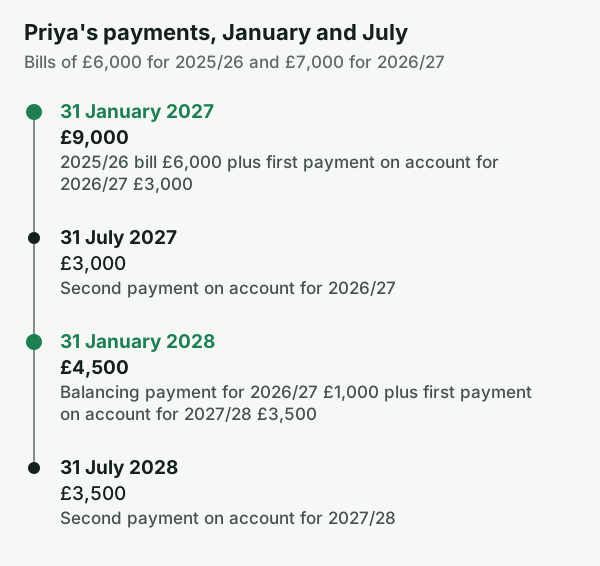
In January 2027 Priya pays £9,000 against a £6,000 bill. That is the second-year shock. It is not extra tax. She is paying part of 2026/27 early. After that first year, the pattern settles into roughly half of each year's bill every January and July, with a top-up or refund in January.
To see what your own profit means for your bill, try the sole trader take-home calculator, then halve the result for each payment on account.
How to plan for it
The simplest approach is to set money aside as you earn, so you have one and a half times your expected bill ready for your first January with payments on account. Our guide to how much should I put aside for tax self employed gives percentages at different profit levels.
You can also pay early. GOV.UK says you can make weekly or monthly payments towards your bill before the deadline.
Both 2027 dates fall at weekends. 31 January 2027 is a Sunday and 31 July 2027 is a Saturday. GOV.UK says payments should reach HMRC on the last working day before a weekend deadline, unless you pay by Faster Payments or card. The full list of dates is in our guide to the self assessment deadline.
Reducing your payments on account
If you expect this year's bill to be lower than last year's, you can ask HMRC to reduce your payments on account. You can apply online or fill in form SA303 and post it.
That might be because your profits have fallen, you have stopped trading, or you will claim more of the costs on our list of what expenses can I claim as a sole trader.
The catch: interest if you cut too far
GOV.UK is clear that if you reduce your payments on account and then owe more than you paid, you will be charged interest on the difference. Late payment interest is set at the Bank of England base rate plus 4%.
Example. Priya expects her 2027/28 bill to fall to £4,000, so she reduces each payment from £3,500 to £2,000. Her actual 2027/28 bill is £5,000. Each payment should have been £2,500, so she was £500 short on each one. HMRC charges interest on those £500 shortfalls from 31 January 2028 and 31 July 2028 until they are paid, and she pays the £1,000 balance on 31 January 2029.
So reduce to a realistic figure, not the lowest one you can justify.
If you miss a payment on account
HMRC charges late payment interest from the first day a payment is late until it is paid in full. Interest only runs on what is unpaid, so paying what you can on time keeps it down.
Does Making Tax Digital change this?
No. If you are in Making Tax Digital for Income Tax, you send quarterly updates and file your return through software, but GOV.UK says it will not change the way you pay tax or the dates payments are due. Payments on account still fall on 31 January and 31 July.
How Holdfast helps
Holdfast works out your payments on account from your own Self Assessment figures and shows a live set-aside figure, so the January and July amounts are already put by. It tracks every HMRC deadline with reminders, and works out returns for sole traders (SA103 box by box) and directors that you can copy into HMRC's online return. The payments on account help article shows where to find them in the app.
Questions
Why is my tax bill so high in my second year?
Because the January after your first full year usually includes two things. You pay last year's bill, plus a first payment on account towards this year, which is half of last year's bill. So you pay about one and a half times your bill in one go.
Do I have to make payments on account?
Not if last year's Self Assessment bill was under £1,000, or if more than 80% of last year's tax was paid outside Self Assessment, for example through PAYE on a salary.
Can I reduce my payments on account?
Yes, if you expect this year's bill to be lower. Apply online or post form SA303 to HMRC. If you reduce them too far and end up owing more, HMRC charges interest on the difference.
Does Making Tax Digital change payments on account?
No. GOV.UK says Making Tax Digital for Income Tax will not change the way you pay tax or the dates payments are due.
Sources
- www.gov.uk/understand-self-assessment-bill/payments-on-account
- www.gov.uk/government/publications/self-assessment-claim-to-reduce-payments-on-account-sa303
- www.gov.uk/self-assessment-tax-returns/deadlines
- www.gov.uk/pay-self-assessment-tax-bill
- www.gov.uk/government/publications/rates-and-allowances-hmrc-interest-rates-for-late-and-early-payments/rates-and-allowances-hmrc-interest-rates
- www.gov.uk/guidance/use-making-tax-digital-for-income-tax/submit-your-tax-return
This guide is general information, not financial, tax or legal advice. Tax rules change, so check GOV.UK or ask HMRC if you're unsure. Read our terms.
Try it and read more
- Sole trader take-home pay calculator 2026/27Free calculator
- Payments on accountPayments on account are advance payments towards your next Self Assessment bill, due on 31 January and 31 July.
- How to pay HMRCThe ways to pay your Self Assessment bill, how long each takes to reach HMRC, the right reference and what to do if you can't pay.
- Self Assessment deadlines and key datesThe dates that matter for Self Assessment: registering, filing on paper or online, paying, and payments on account.
More tax guides
- Capital Gains Tax allowance and rates 2026/27The 2026/27 Capital Gains Tax allowance is £3,000. Gains above it are taxed at 18% or 24%, property included, and UK residential gains are due within 60 days.
- High Income Child Benefit Charge explainedThe High Income Child Benefit Charge takes back 1% of Child Benefit for every £200 of adjusted net income over £60,000, and all of it once you reach £80,000.
- HMRC scam emails, texts and calls: how to spot and report themForward HMRC scam emails to phishing@hmrc.gov.uk and scam texts to 60599. HMRC never threatens arrest, asks for gift vouchers or offers refunds on social media.
- HMRC Time to Pay: Self Assessment payment plansIf you cannot pay your Self Assessment bill, you may be able to set up an HMRC payment plan (Time to Pay) online or by phone. Interest is still charged.