Sole trader or limited company?
Sole trader or limited company? With 2026/27 rates a company rarely saves tax if you take all the profit out. See the sums at three profit levels.
If you take all your profit out each year, a limited company rarely saves you tax in 2026/27. At £30,000 to £60,000 of profit, a sole trader keeps about the same or slightly more, and has far less admin.
A company makes more sense when you can leave profit inside it, when limited liability matters, or when a client will only work with a company. This guide compares the two with real sums, using rates for England, Wales and Northern Ireland for 6 April 2026 to 5 April 2027.
The basic difference
Sole trader. You and the business are the same person. You make the decisions and keep the profit after tax. You pay Income Tax and Class 4 National Insurance on all your profit through Self Assessment, whether you spend it or not. You are personally responsible for all the business's debts.
Limited company. The company is a separate legal person. It pays corporation tax on its profit. You are a director and usually the shareholder, and you take money out as salary, dividends or both. Shareholders are only responsible for the company's debts up to what they invested.
How each is taxed in 2026/27
Sole trader
- Income Tax: 0% on the first £12,570, 20% up to £50,270, 40% above that.
- Class 4 National Insurance: 6% on profits from £12,570 to £50,270, 2% above.
- Class 2 is treated as paid once your profit is £7,105 or more, so it costs nothing.
Our guide to how much tax a sole trader pays explains these step by step.
Limited company
- Corporation tax: 19% on profits of £50,000 or less, 25% over £250,000, with marginal relief giving a rate in between.
- Salary: employer's National Insurance is 15% on pay above £5,000. A company whose only employee paid enough to trigger employer's NI is its sole director cannot claim Employment Allowance to cover it.
- Dividends: the first £500 is tax-free. Above that, 10.75% in the basic rate band, 35.75% in the higher rate band and 39.35% above that. There is no National Insurance on dividends.
Dividend tax went up by 2 percentage points on 6 April 2026 (from 8.75% and 33.75%). It makes dividends less attractive than they were in 2025/26.
The usual way to pay yourself from a one-person company is a £12,570 salary with the rest as dividends. Our salary vs dividends guide explains why.
Worked comparison at three profit levels
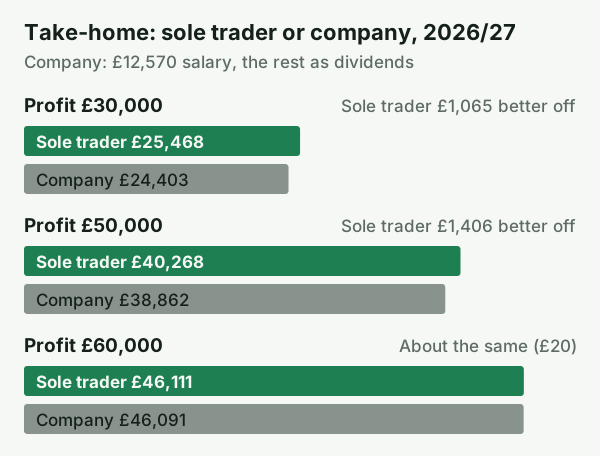
Same business, same profit before paying yourself, two structures. The company pays a £12,570 salary, then pays out everything left after corporation tax as dividends. There is no other income, no associated companies and no Employment Allowance. Figures are rounded to the nearest pound.
| Profit | Sole trader keeps | Company director keeps | Difference |
|---|---|---|---|
| £30,000 | £25,468 | £24,403 | Sole trader £1,065 better off |
| £50,000 | £40,268 | £38,862 | Sole trader £1,406 better off |
| £60,000 | £46,111 | £46,091 | About the same (£20) |
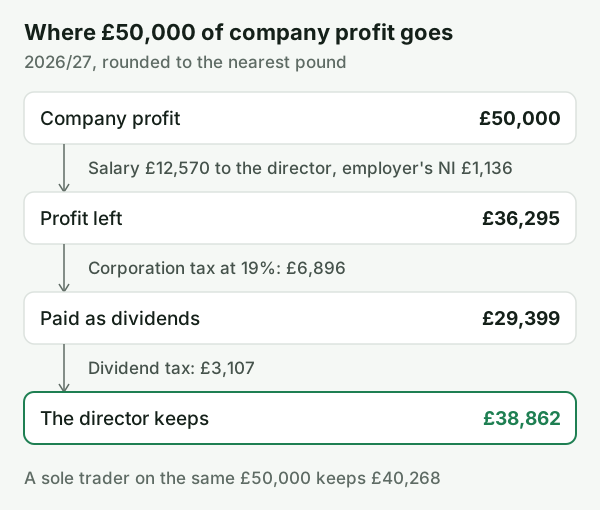
Where the money goes at £50,000
As a sole trader: Income Tax £7,486 and Class 4 £2,246. You keep £40,268.
Through a company:
- The company pays your £12,570 salary and £1,136 of employer's NI.
- That leaves £36,295 of profit. Corporation tax at 19% is £6,896.
- The company pays you the remaining £29,399 as dividends.
- You pay no tax on the salary (it is covered by your Personal Allowance) and £3,107 of dividend tax.
- You keep £38,862.
Check your own company's figures with the salary vs dividends calculator.
Why the company does not win here
Look at each extra £100 of profit once the £12,570 salary is paid:
- Basic rate: a sole trader keeps £74. Through a company, after 19% corporation tax and 10.75% dividend tax, you keep £72.29.
- Higher rate: a sole trader keeps £58. Through a company you keep £52.04 at 19% corporation tax, or £48.19 at 25%.
The only stretch where the company catches up is just above £50,270, where the sole trader has moved into the higher rate band but the director's dividends are still in the basic rate band. That is why the two are level at £60,000.
When a company can still make sense
- You leave profit in the company. Profit you don't take out has only paid corporation tax, 19% on the first £50,000. Dividend tax is due only when you take it out. A sole trader pays full Income Tax and NI on all the profit in the year it is made.
- Limited liability. If the business could build up debts or claims, keeping them separate from your home and savings may matter more than a few hundred pounds of tax.
- A client insists. If a client will only contract with a company, you may have no choice. If you work through your company for a client in a way that looks like employment, the off-payroll working rules (IR35) may apply, which aim to make you pay broadly the same tax and NI as an employee. Medium and large private clients, and public sector clients, usually decide your status. For small private clients, your company decides.
The admin difference
| Task | Sole trader | Limited company |
|---|---|---|
| Register | Register for Self Assessment | Register the company before it trades |
| Yearly returns | One Self Assessment return | Annual accounts, a Company Tax Return and a confirmation statement, plus your own Self Assessment if you have dividends to declare |
| Payroll | None | Run payroll to pay yourself a salary |
| Taking money out | Take what you like | Follow the rules: salary through payroll, dividends only from profits, with paperwork |
| Responsibility | Your own records | You are legally responsible for the company's records, accounts and performance, even if someone else does them |
Directors can be fined, prosecuted or disqualified if they don't meet their responsibilities. Our guide to whether company directors need to do a Self Assessment covers the personal return.
A simple way to decide
- Will you take out nearly all the profit each year? If yes, stay a sole trader on tax grounds alone, at least up to about £60,000.
- Will you leave a good share of profit in the business? Run both sums. The company may come out ahead.
- Does limited liability matter for your work, or does a client require a company? That can tip it, whatever the tax.
You can start as a sole trader and switch later. Many people do once their profit grows or they start keeping money in the business.
How Holdfast helps
Holdfast handles both. For sole traders it works out your Self Assessment, including the SA103 self-employment pages box by box, and tells you what to set aside. For companies it keeps the books, runs director payroll, works out corporation tax and files confirmation statements and micro-entity accounts to Companies House. The what is Holdfast help article shows what each plan covers, and there's a 14-day trial (card needed).
Questions
At what profit is a limited company worth it?
There is no single figure. With 2026/27 rates, if you take all the profit out each year, a one-person company leaves you with about the same or less than being a sole trader at £30,000 to £60,000 of profit. A company helps more when you can leave profit in it, or when limited liability matters to you.
Is my personal money safe in a limited company?
Mostly. Shareholders are responsible for the company's debts only up to what they invested. As a sole trader you are personally responsible for all the business's debts. Directors can still be fined, prosecuted or disqualified if they don't meet their duties.
Do I pay less National Insurance in a limited company?
Usually, because dividends carry no National Insurance. But the company pays corporation tax on its profit first, and with the 2026/27 dividend rates that now cancels out most of the saving.
Sources
- www.gov.uk/set-up-business
- www.gov.uk/running-a-limited-company
- www.gov.uk/government/publications/rates-and-allowances-income-tax/income-tax-rates-and-allowances-current-and-past
- www.gov.uk/self-employed-national-insurance-rates
- www.gov.uk/tax-on-dividends
- www.gov.uk/corporation-tax-rates
- www.gov.uk/guidance/rates-and-thresholds-for-employers-2026-to-2027
- www.gov.uk/claim-employment-allowance/eligibility
- www.gov.uk/guidance/understanding-off-payroll-working-ir35
This guide is general information, not financial, tax or legal advice. Tax rules change, so check GOV.UK or ask HMRC if you're unsure. Read our terms.
Try it and read more
- Salary vs dividends calculator 2026/27Free calculator
- What Holdfast doesHoldfast keeps your books, works out your tax and shows what's really yours, for your own money, the self-employed and limited companies.
- Corporation tax and your CT600Holdfast works out your company's corporation tax and prepares the CT600 return, with the dates to pay and file.
- Income Tax and National Insurance ratesThe 2026/27 Income Tax bands and self-employed National Insurance rates, with worked examples and how Holdfast works out your bill.
More limited companies guides
- Companies House late filing penaltiesLate accounts cost a private company £150 to £1,500 depending on how late, doubled if late two years running. Deadlines, the full table and how appeals work.
- Corporation tax deadlines and the CT600 returnPay corporation tax 9 months and 1 day after your accounting period ends and file the CT600 within 12 months. Penalties start at £200 and interest runs daily.
- Corporation tax rates and marginal relief explainedCorporation tax is 19% on profits up to £50,000 and 25% over £250,000. In between, marginal relief applies. Here is how it works, with the maths shown.
- Dormant company accounts and telling HMRCA dormant company still files accounts and a confirmation statement at Companies House every year. HMRC and Companies House define dormant differently.