Salary vs dividends in 2026/27
Salary or dividends? For most UK company directors a £12,570 salary plus dividends costs the least tax in 2026/27. See how each is taxed, with worked sums.
For most UK limited company directors in 2026/27, the cheapest way to pay yourself is a salary of £12,570 with the rest as dividends. Salary up to that point is tax-free for you and saves the company corporation tax, while above it dividends usually cost less tax than more salary because they carry no National Insurance.
This guide shows how each is taxed and where the answer changes. It uses rates for England, Wales and Northern Ireland for 6 April 2026 to 5 April 2027.
How salary is taxed
Salary is paid through payroll. The company must be registered as an employer and deduct tax and National Insurance (NI) each time it pays you.
- Employer's NI: 15% on pay above £5,000 a year. The company pays this.
- Employee NI: 8% on pay between £12,570 and £50,270, then 2% above that.
- Income Tax: 0% up to your £12,570 personal allowance, 20% on the next £37,700, 40% above that.
The good part: salary and employer's NI are business costs. They reduce the company's profit, so the company pays less corporation tax.
How dividends are taxed
A dividend is a payment to shareholders out of the company's profit. GOV.UK sets three rules:
- Dividends cannot be more than the company's available profits from this year and earlier years.
- Each one needs a directors' meeting to declare it, minutes of that meeting and a dividend voucher.
- Dividends are not a business cost, so they do not reduce corporation tax.
Corporation tax comes first: 19% on profits up to £50,000, 25% over £250,000, and somewhere in between for profits in the middle (called marginal relief).
Then you pay personal tax on what you receive. For 2026/27:
| Band | Dividend tax rate |
|---|---|
| First £500 (dividend allowance) | 0% |
| Basic rate | 10.75% |
| Higher rate | 35.75% |
| Additional rate | 39.35% |
There is no NI on dividends. The basic and higher rates both went up by 2 percentage points on 6 April 2026 (from 8.75% and 33.75%).
How the bands stack
To find your band, GOV.UK says to add your dividends to your other income, and dividends can fall into more than one band. In practice your salary uses your personal allowance first. Then dividends fill whatever is left of the allowance, then the basic rate band, then the higher rate band. So with a £12,570 salary, you can take roughly £37,700 of dividends before any of them hit the 35.75% rate.
The comparison, per £100
The fair test is: for every £100 of profit the company spends on you, how much ends up in your pocket? These figures assume your salary is already £12,570 and your dividend allowance is used.
| Route | Basic rate taxpayer | Higher rate taxpayer |
|---|---|---|
| More salary (company pays employer's NI) | £62.61 | £50.43 |
| Dividend, company pays 19% corporation tax | £72.29 | £52.04 |
| Dividend, company pays 25% corporation tax | £66.94 | £48.19 |
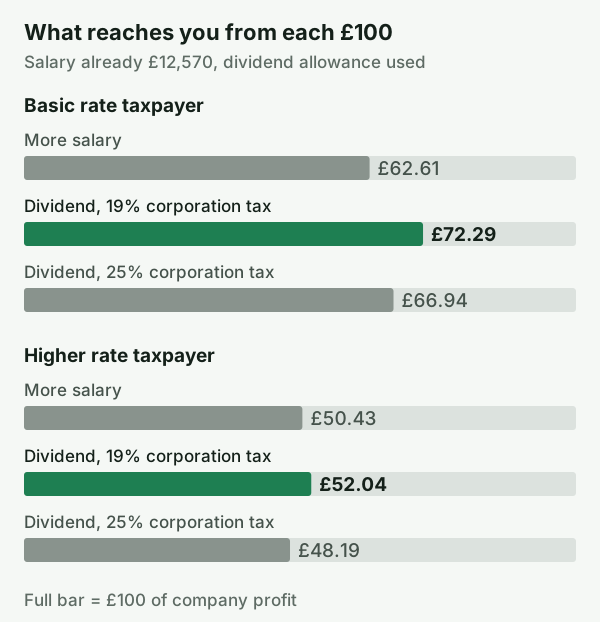
What this shows:
- Basic rate: dividends win at every corporation tax rate.
- Higher rate: dividends still just win at 19%. But if the company pays 25% corporation tax, more salary edges ahead.
- Below £12,570: salary wins, as explained in our guide to how much salary a director should take in 2026/27.
What Employment Allowance changes
Employment Allowance cuts employer's NI by up to £10,500 a year. A company cannot claim it if its only director is the only employee who earns enough to trigger employer's NI. If your company can claim it, extra salary costs no employer's NI while the allowance lasts. Then £100 of salary leaves you £72 at basic rate, or £58 at higher rate. That beats dividends at the 25% corporation tax rate, and roughly ties at 19%.
Worked example
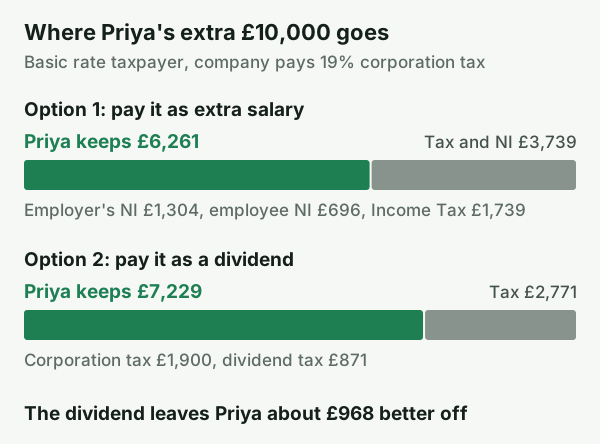
Priya is a director and the only shareholder of her company. She already takes a £12,570 salary and some dividends, and she is a basic rate taxpayer. Her company makes an extra £10,000 of profit and pays 19% corporation tax. It cannot claim Employment Allowance.
Option 1: pay it as extra salary
- The company can afford £8,696 of salary plus £1,304 of employer's NI (£10,000 in total). No corporation tax is due on it.
- Priya pays £696 of employee NI and £1,739 of Income Tax.
- Priya keeps £6,261.
Option 2: pay it as a dividend
- The company pays £1,900 of corporation tax and pays Priya a dividend of £8,100.
- Priya pays £871 of dividend tax at 10.75%.
- Priya keeps £7,229.
The dividend route leaves Priya about £968 better off on this £10,000.
Run your own numbers in the salary vs dividends calculator.
Other things to weigh
- Your other income. If you have a job or pension, your personal allowance may already be used, and even a small salary is taxed. A salary of £5,000 or £6,708 is often better then.
- Income over £100,000. Your personal allowance goes down by £1 for every £2 of income above £100,000. Salary and dividends both count, so large dividends can cost more than the headline rate.
- Self Assessment. Dividend tax is paid through your own tax return. For dividends received in 2026/27, the return and payment are due by 31 January 2028. Set money aside as you go. Our guide to Self Assessment for company directors explains when you need to file.
- Paperwork. A dividend with no profits to back it, or no minutes and voucher, may be treated as a loan from the company instead. See our guide to the director's loan account and s455.
- Other shareholders. Dividends are usually paid to all shareholders in proportion to their shares, so a dividend is not always just "your" pay.
How Holdfast helps
Holdfast keeps your company books, runs director payroll and shows how much profit is available before you declare a dividend. It creates the dividend voucher and board minutes, tracks your director's loan, and works out corporation tax and your Self Assessment figures from the same records. The Income Tax and NI rates help article shows how Holdfast works out your personal bill.
Questions
Are dividends taxed less than salary?
Usually, yes. In 2026/27 dividends above the £500 allowance are taxed at 10.75% (basic rate) and 35.75% (higher rate), with no National Insurance. But the company pays corporation tax on profit before it can pay a dividend, so you have to compare the whole route, not just the personal tax.
Can I take all my pay as dividends and no salary?
You can, but you usually lose out. A salary up to £12,570 is tax-free for you and saves the company corporation tax, so most directors take that much as salary first.
Do I pay National Insurance on dividends?
No. National Insurance applies to salary, not dividends. That is one of the main reasons dividends are cheaper for most directors.
Sources
- www.gov.uk/running-a-limited-company/taking-money-out-of-a-limited-company
- www.gov.uk/tax-on-dividends
- www.gov.uk/government/publications/rates-and-allowances-income-tax/income-tax-rates-and-allowances-current-and-past
- www.gov.uk/guidance/rates-and-thresholds-for-employers-2026-to-2027
- www.gov.uk/corporation-tax-rates
- www.gov.uk/claim-employment-allowance/eligibility
This guide is general information, not financial, tax or legal advice. Tax rules change, so check GOV.UK or ask HMRC if you're unsure. Read our terms.
Try it and read more
- Salary vs dividends calculator 2026/27Free calculator
- Income Tax and National Insurance ratesThe 2026/27 Income Tax bands and self-employed National Insurance rates, with worked examples and how Holdfast works out your bill.
- Running payrollHoldfast works out pay, tax, National Insurance, student loans and pensions each payday, and what you owe HMRC.
- Your Self Assessment returnHow Holdfast estimates your Self Assessment tax, builds your return with every step explained, and lists what needs a look.
More pay yourself guides
- Company car benefit in kind: how it's taxed in 2026/27Company car benefit is the list price times a CO2-based percentage: 4% for electric cars in 2026/27, rising to 9% by 2029/30. The company pays 15% Class 1A.
- Director pension contributions through your companyYour company can pay into your pension as a business cost, with no Income Tax or NI for you, up to the £60,000 annual allowance plus 3 years' unused allowance.
- Dividend tax rates and allowance for 2026/27In 2026/27 the first £500 of dividends is tax-free, then dividends are taxed at 10.75%, 35.75% or 39.35% depending on your band. See worked examples.
- Employment Allowance for sole director companiesEmployment Allowance cuts employer's NI by up to £10,500 in 2026/27, but not if your only director is the only employee paid over the £5,000 threshold.