How much tax do I pay as a sole trader?
Sole traders pay Income Tax and Class 4 National Insurance on profit, not sales. See the 2026/27 rates and what you keep at £20,000 to £60,000.
As a sole trader you pay Income Tax and Class 4 National Insurance on your profit, which is your income minus your allowable expenses. In 2026/27 the first £12,570 of profit is free of both, then you pay 26% (20% Income Tax plus 6% National Insurance) up to £50,270, and 42% above that.
So on a £30,000 profit you pay about £4,532 and keep about £25,468. This guide shows how that works, with rates for England, Wales and Northern Ireland for 6 April 2026 to 5 April 2027. The rates are the same as in 2025/26.
If you run a limited company instead, the rules are different. See our guide to salary vs dividends.
Step 1: work out your profit
You are taxed on profit, not sales. Take your business income for the tax year and subtract your allowable expenses, such as stock, software, travel and the business share of your phone bill.
Money you take out of the business for yourself is not an expense. As a sole trader, what you "pay yourself" makes no difference to your tax. You are taxed on the whole profit whether you leave it in the bank or spend it.
Every £100 of expenses you can claim saves you £26 at basic rate. Our guide to what expenses you can claim as a sole trader lists what counts.
Step 2: Income Tax
Income Tax on your profit (plus any other income, such as a job) uses these bands for 2026/27:
| Band | Taxable income | Rate |
|---|---|---|
| Personal Allowance | Up to £12,570 | 0% |
| Basic rate | £12,571 to £50,270 | 20% |
| Higher rate | £50,271 to £125,140 | 40% |
| Additional rate | Over £125,140 | 45% |
Your Personal Allowance goes down by £1 for every £2 of income above £100,000. It is zero once your income reaches £125,140.
Scottish taxpayers pay Scottish Income Tax rates and bands, which are different.
Step 3: Class 4 National Insurance
Class 4 is National Insurance for the self-employed. For 2026/27 you pay:
- 0% on profits up to £12,570
- 6% on profits from £12,570 to £50,270
- 2% on profits over £50,270
What about Class 2?
You no longer have to pay Class 2. If your profit is £7,105 or more, Class 2 is treated as paid, so your National Insurance record is protected without you paying anything. If your profit is below £7,105, you can choose to pay voluntary Class 2 at £3.65 a week to protect your record.
Worked example: £30,000 profit
Leila is a self-employed photographer. Her sales for 2026/27 are £38,000 and her allowable expenses are £8,000, so her profit is £30,000. She has no other income.
- Profit above the Personal Allowance: £30,000 minus £12,570 = £17,430
- Income Tax at 20%: £3,486
- Class 4 at 6%: £1,045.80
- Total tax: £4,531.80, or about 15% of her profit
- Leila keeps £25,468.20
To be ready for that bill, she needs to put aside about £378 a month.
Try your own figures in the sole trader take-home calculator.
What you keep at different profits
All figures are for 2026/27, with no other income, rounded to the nearest pound.
| Profit | Income Tax | Class 4 NI | Total tax | You keep |
|---|---|---|---|---|
| £20,000 | £1,486 | £446 | £1,932 | £18,068 |
| £30,000 | £3,486 | £1,046 | £4,532 | £25,468 |
| £50,000 | £7,486 | £2,246 | £9,732 | £40,268 |
| £60,000 | £11,432 | £2,457 | £13,889 | £46,111 |
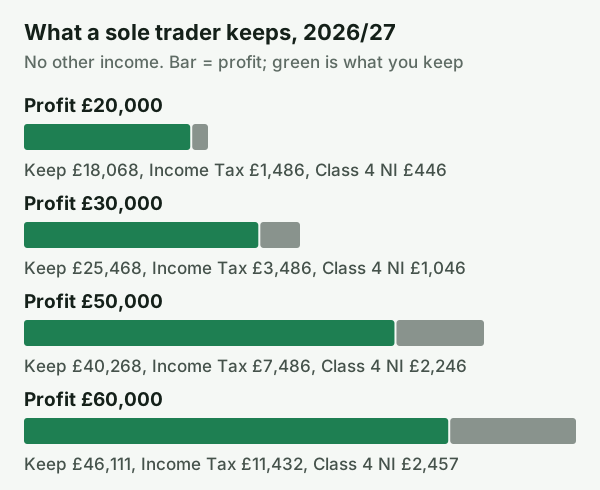
Notice the jump between £50,000 and £60,000. The extra £10,000 costs £4,157 in tax, because most of it falls in the higher rate band at 40% Income Tax plus 2% National Insurance.
When you pay
There is no tax taken from a sole trader's income as it comes in. You pay it all through Self Assessment.
- The online return and the payment for a tax year are due by 31 January after it ends. For 2025/26, that is 31 January 2027.
- If your bill is £1,000 or more, you usually also make payments on account towards next year: half of this year's bill on 31 January and half on 31 July.
You do not have to make payments on account if your last bill was under £1,000, or if more than 80% of your tax was already paid another way, for example through PAYE on a job.
What this means in your first full year
Say Leila's £4,531.80 bill for 2026/27 is her first. On 31 January 2028 she pays that bill plus a first payment on account of £2,265.90. Then on 31 July 2028 she pays another £2,265.90.
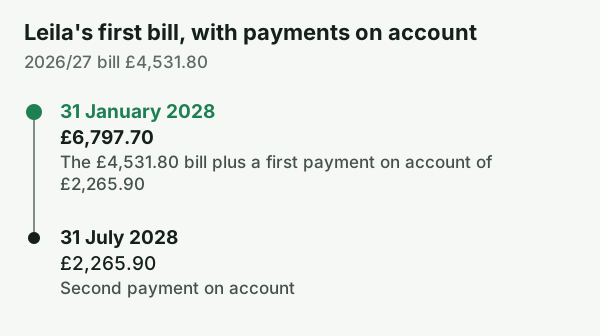
That is £6,797.70 due in one go in January. It catches many people out in their second year. Our guide to how much you should put aside for tax when self employed shows how to build the pot, and payments on account explained covers how to reduce them if your profit falls.
If you also have a job
Your profit is added to your salary. Your Personal Allowance is usually used up by your job first, so your profit is taxed from the first pound at 20% (or 40% if your salary already takes you into the higher rate band). Class 4 is worked out on your profit alone, so it still starts at £12,570 of profit.
How Holdfast helps
Holdfast works out your Income Tax and Class 4 from your own books as you go and tells you how much to set aside each month, including payments on account. It prepares your Self Assessment and the SA103 self-employment pages box by box for you to copy into HMRC's online return (sending it straight to HMRC is coming soon). The Income Tax and National Insurance help article explains how it works out your bill.
Questions
Do I pay tax on my sales or my profit?
On your profit. That is your income from the business minus your allowable expenses. A sole trader with £40,000 of sales and £10,000 of expenses pays tax on £30,000.
Do I still have to pay Class 2 National Insurance?
Not if your profit is £7,105 or more in 2026/27. At that level Class 2 is treated as paid, which protects your National Insurance record for free. Below it, you can choose to pay £3.65 a week.
Why is my second tax bill so much bigger than the first?
Because of payments on account. If last year's bill was £1,000 or more, HMRC usually asks for half of it in advance on 31 January and half on 31 July, on top of the bill for the year just gone.
Sources
- www.gov.uk/government/publications/rates-and-allowances-income-tax/income-tax-rates-and-allowances-current-and-past
- www.gov.uk/self-employed-national-insurance-rates
- www.gov.uk/income-tax-rates/income-over-100000
- www.gov.uk/understand-self-assessment-bill/payments-on-account
- www.gov.uk/self-assessment-tax-returns/deadlines
- www.gov.uk/expenses-if-youre-self-employed
This guide is general information, not financial, tax or legal advice. Tax rules change, so check GOV.UK or ask HMRC if you're unsure. Read our terms.
Try it and read more
- Sole trader take-home pay calculator 2026/27Free calculator
- Income Tax and National Insurance ratesThe 2026/27 Income Tax bands and self-employed National Insurance rates, with worked examples and how Holdfast works out your bill.
- Payments on accountPayments on account are advance payments towards your next Self Assessment bill, due on 31 January and 31 July.
- Your Self Assessment returnHow Holdfast estimates your Self Assessment tax, builds your return with every step explained, and lists what needs a look.
More pay yourself guides
- Company car benefit in kind: how it's taxed in 2026/27Company car benefit is the list price times a CO2-based percentage: 4% for electric cars in 2026/27, rising to 9% by 2029/30. The company pays 15% Class 1A.
- Director pension contributions through your companyYour company can pay into your pension as a business cost, with no Income Tax or NI for you, up to the £60,000 annual allowance plus 3 years' unused allowance.
- Dividend tax rates and allowance for 2026/27In 2026/27 the first £500 of dividends is tax-free, then dividends are taxed at 10.75%, 35.75% or 39.35% depending on your band. See worked examples.
- Employment Allowance for sole director companiesEmployment Allowance cuts employer's NI by up to £10,500 in 2026/27, but not if your only director is the only employee paid over the £5,000 threshold.