Do company directors need to do a Self Assessment?
Being a director doesn't on its own mean you file. Dividends over £10,000, a director's loan over £10,000 or other untaxed income usually do. Here is what goes where.
Being a company director does not, on its own, mean you have to file a Self Assessment tax return. You need one because of what you take out: most directors who take more than £10,000 in dividends, owe their company more than £10,000, or have other untaxed income must file.
In a typical one-person limited company, the director takes a small salary and the rest as dividends, so in practice most of them do file. This guide explains when you need to, what goes on the return, and how dividend tax is worked out.
When a director has to file
GOV.UK's list of who must send a tax return does not include being a director by itself. It covers sole traders earning more than £1,000, partners, people with Capital Gains Tax to pay, and a few others. It also says you may need to file if you have untaxed income, and lists dividends as an example.
For directors, these are the usual triggers:
- Dividends over £10,000. GOV.UK says you will need to fill in a Self Assessment tax return.
- Dividends over your allowances but £10,000 or less. You must tell HMRC, but you can choose: report them on a return, or tell HMRC between 5 April and 5 October and ask them to collect the tax through your tax code.
- A director's loan over £10,000. GOV.UK says you must report the loan on a personal Self Assessment tax return.
- A director's loan written off. You pay Income Tax on it through Self Assessment.
- Interest your company pays you on money you have lent it. That is personal income, reported on your return.
If your dividends fit inside your unused Personal Allowance and the £500 dividend allowance, you do not need to tell HMRC about them.
If you have never filed before, tell HMRC by 5 October after the end of the tax year. For 2025/26 that was 5 October 2026. The return and the tax are due by 31 January 2027. Every date is in our guide to the self assessment deadline.
Salary: tax is already taken
A director's salary goes through payroll, so Income Tax and National Insurance are taken before you are paid. It still goes on your return if you file, so HMRC can work out the tax on everything else. Your P60 gives the pay and tax figures.
Many directors pay themselves a salary of £12,570, the same as the Personal Allowance. Our guide to salary vs dividends explains why.
Which pages to fill in
SA100: the main return
Dividends from your company go in box 4, "Dividends from UK companies", on the SA100. HMRC's notes say to put in the total from your dividend vouchers, and to include all dividend income even if it is under £500, because it counts towards your tax bands.
SA102: the Employment page
HMRC's notes say to fill in an Employment page if you were a director of a UK company, including a dormant one. You need one for each directorship. The only exception is directors of a charity or community interest company who received no pay, dividends or other distribution from it.
On the 2025/26 SA102:
- Boxes 1 and 2: pay and tax from your P60
- Box 6: put X if you were a company director
- Box 7: put X if the company was a close company. HMRC's notes say a company is close if it is UK resident and controlled by its directors or by 5 or fewer participators, such as shareholders. Most one-person companies are.
- Box 7.1 and 7.2: the company's name and registration number
- Box 7.3: dividends you received from this company (the same income as SA100 box 4), or zero
- Box 7.4: your percentage shareholding, the highest it was during the year
- Boxes 9 to 20: benefits from your P11D, unless your company payrolled them
How dividend tax is worked out
You get a £500 dividend allowance. Dividends are added on top of your other income, and the band they land in sets the rate.
| Rate | 2025/26 | 2026/27 |
|---|---|---|
| Basic rate | 8.75% | 10.75% |
| Higher rate | 33.75% | 35.75% |
| Additional rate | 39.35% | 39.35% |
The basic rate band is £37,700 above the £12,570 Personal Allowance, so it ends at £50,270 of total income. The £500 allowance is tax-free but still uses up band space.
If you live in Scotland, your salary is taxed at Scottish rates, but GOV.UK says you pay the same tax as the rest of the UK on dividends.
Worked example
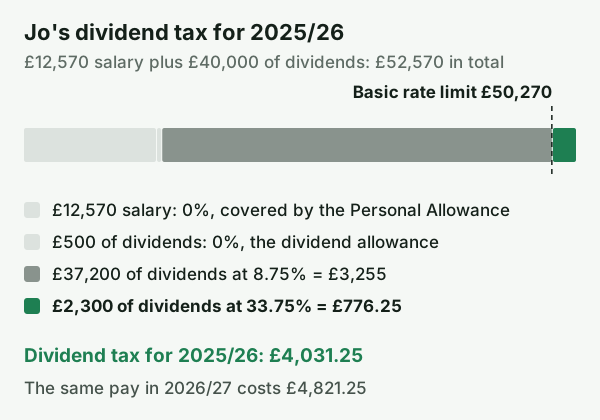
Jo is the only director and shareholder of her company. In 2025/26 she took a £12,570 salary and £40,000 in dividends. She has no other income.
- Salary: covered by her Personal Allowance, so no Income Tax
- Total income: £52,570, which is £2,300 over the £50,270 basic rate limit
- First £500 of dividends: dividend allowance, 0%
- Next £37,200: basic rate, 8.75% = £3,255
- Last £2,300: higher rate, 33.75% = £776.25
- Dividend tax for 2025/26: £4,031.25, due by 31 January 2027
The same pay in 2026/27 costs £4,821.25 (£3,999 at 10.75% plus £822.25 at 35.75%), because both rates rose by 2 percentage points on 6 April 2026.
Jo's bill is over £1,000 and none of it was paid through PAYE, so HMRC will also ask for payments on account. On 31 January 2027 she pays the £4,031.25 plus a first payment on account for 2026/27 of half that, about £2,016. Our guide to payments on account explained shows how that settles down.
You can test other mixes of salary and dividends in the salary vs dividends calculator.
The director's loan angle
Money you take from your company that is not salary, dividends or a repaid expense goes on your director's loan account.
- You owe the company more than £10,000: it is treated as a benefit in kind, and you report the loan on your Self Assessment return. If you pay less than HMRC's official rate of interest, you may owe tax on the difference.
- The loan is written off: you pay Income Tax on it through Self Assessment, and the company deducts Class 1 National Insurance through payroll.
- Not repaid within 9 months of the company's year end: the company, not you, pays s455 tax. The law ties the rate to the dividend upper rate for the year the loan was made, so 33.75% for 2025/26 loans and 35.75% for loans from 6 April 2026. Our guide to the director's loan account s455 explains how to get it back.
- The company pays you interest on money you lent it: the company takes off 20% Income Tax before paying you, and you report the interest on your return.
A common fix for an overdrawn loan is to clear it with a dividend. That only works if the company has the profits to pay one, and the dividend then goes on your return like any other.
How Holdfast helps
Holdfast works out your Self Assessment as a director from your own books, including dividends with vouchers, director's loan tracking, Scottish rates and payments on account, so you can copy the figures into HMRC's online return (sending returns to HMRC is coming soon). It keeps a live set-aside figure and reminds you of HMRC deadlines. The Self Assessment help article shows how to get started, with a 14-day trial.
Questions
Do I need a tax return if I only take a salary from my company?
Not just for that. Salary goes through payroll, so the tax is taken before you are paid. You would need a return if you also have untaxed income, such as dividends over £10,000, or another reason on GOV.UK's list.
Do I need a tax return if my dividends are under £10,000?
Not necessarily. If your dividends are covered by your unused Personal Allowance and the £500 dividend allowance, you do not need to tell HMRC. If they are above that but no more than £10,000, you can ask HMRC to collect the tax through your tax code instead, by telling them between 5 April and 5 October.
Where do dividends from my own company go on the tax return?
In box 4 of the main SA100 return, "Dividends from UK companies". On the 2025/26 return, directors of close companies also enter them in box 7.3 of the Employment page (SA102), with the company's name, number and their shareholding.
Sources
- www.gov.uk/self-assessment-tax-returns/who-must-send-a-tax-return
- www.gov.uk/tax-on-dividends
- www.gov.uk/tax-on-dividends/how-to-report-tax-on-dividends
- www.gov.uk/government/publications/rates-and-allowances-income-tax/income-tax-rates-and-allowances-current-and-past
- www.gov.uk/government/publications/self-assessment-tax-return-sa100
- www.gov.uk/government/publications/self-assessment-employment-sa102
- assets.publishing.service.gov.uk/media/6a9ea0015a0c25165ae469d3/SA102_-Notes_2026.pdf
- assets.publishing.service.gov.uk/media/6a9ea8a5df4246cf45e469e0/SA150_Notes_2026.pdf
- www.gov.uk/directors-loans/you-owe-your-company-money
- www.gov.uk/directors-loans/you-lend-your-company-money
- www.legislation.gov.uk/ukpga/2010/4/section/455
- www.gov.uk/self-assessment-tax-returns/deadlines
- www.gov.uk/understand-self-assessment-bill/payments-on-account
- www.gov.uk/scottish-income-tax
This guide is general information, not financial, tax or legal advice. Tax rules change, so check GOV.UK or ask HMRC if you're unsure. Read our terms.
Try it and read more
- Salary vs dividends calculator 2026/27Free calculator
- Your Self Assessment returnHow Holdfast estimates your Self Assessment tax, builds your return with every step explained, and lists what needs a look.
- Your director's loan and s455Money you take from your company that isn't salary or dividends goes on your director's loan. Holdfast tracks it and the deadline to repay.
- Income Tax and National Insurance ratesThe 2026/27 Income Tax bands and self-employed National Insurance rates, with worked examples and how Holdfast works out your bill.
More tax guides
- Capital Gains Tax allowance and rates 2026/27The 2026/27 Capital Gains Tax allowance is £3,000. Gains above it are taxed at 18% or 24%, property included, and UK residential gains are due within 60 days.
- High Income Child Benefit Charge explainedThe High Income Child Benefit Charge takes back 1% of Child Benefit for every £200 of adjusted net income over £60,000, and all of it once you reach £80,000.
- HMRC scam emails, texts and calls: how to spot and report themForward HMRC scam emails to phishing@hmrc.gov.uk and scam texts to 60599. HMRC never threatens arrest, asks for gift vouchers or offers refunds on social media.
- HMRC Time to Pay: Self Assessment payment plansIf you cannot pay your Self Assessment bill, you may be able to set up an HMRC payment plan (Time to Pay) online or by phone. Interest is still charged.