Self Assessment deadlines for 2025/26 (and what happens if you miss them)
The 2025/26 Self Assessment return and bill are due by 31 January 2027. Every date, the late filing and payment penalties, interest and what MTD changes.
The online deadline for your 2025/26 Self Assessment tax return is 11:59pm on 31 January 2027, and the tax you owe for 2025/26 must be paid by the same date. If you make payments on account, the second one is due by 31 July 2027.
The 2025/26 tax year ran from 6 April 2025 to 5 April 2026. This guide lists every date that matters for it, what HMRC charges if you are late, and what changes if you have joined Making Tax Digital for Income Tax.
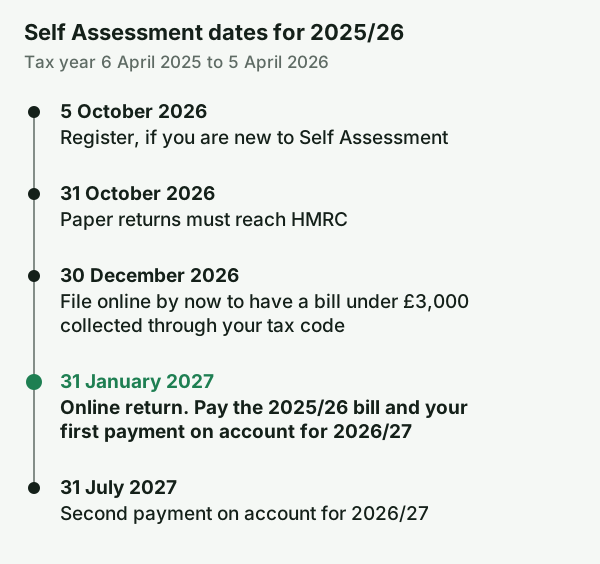
The 2025/26 dates at a glance
| Date | What is due |
|---|---|
| 5 October 2026 | Tell HMRC you need to file, if you are new to Self Assessment |
| 31 October 2026 | Paper returns must reach HMRC by 11:59pm |
| 30 December 2026 | File online by 11:59pm if you want a bill under £3,000 collected through your tax code |
| 31 January 2027 | Online return by 11:59pm. Pay the 2025/26 bill, plus your first payment on account for 2026/27 |
| 31 July 2027 | Second payment on account for 2026/27 |
Registering by 5 October
GOV.UK says you must tell HMRC by 5 October if you need to complete a tax return for the previous year. That applies if you have never sent a return, or if you registered before but did not need to send one for 2024/25.
For 2025/26 that date was 5 October 2026. If you register after it, HMRC sends a letter or email with your own filing deadline, 3 months from the date on it. You must still pay by 31 January 2027 to avoid a penalty.
Not sure you need to file at all? Sole traders whose income was over £1,000 must. Our guide to the £1,000 trading allowance covers side income, and do company directors need to do a self assessment covers directors.
Paper returns: 31 October
A paper return for 2025/26 had to reach HMRC by 11:59pm on 31 October 2026. If you missed it, you can still file online by 31 January 2027.
Paying through your tax code: 30 December
If you are employed or get a pension, HMRC can collect a bill of less than £3,000 through your tax code instead. GOV.UK sets these conditions:
- you file online by 30 December (or on paper by 31 October)
- you already pay tax through PAYE
- you cannot make a part payment to get under £3,000
- it will not happen if you would pay more than 50% of your PAYE income in tax, or more than twice your usual tax
Filing and paying: 31 January
The online return and the 2025/26 bill are both due by 11:59pm on 31 January 2027. If you make payments on account, the first one for 2026/27 is due on the same day. That is why many people pay roughly one and a half times their bill in their first January. Our guide to payments on account explained works through it.
31 January 2027 is a Sunday
You can still file online until 11:59pm that day. Payment is different. GOV.UK says that if a payment deadline falls on a weekend or bank holiday, your payment should reach HMRC on the last working day before, which is Friday 29 January 2027. This does not apply to Faster Payments or debit and credit card payments, which arrive the same or next day. Bacs takes 3 working days.
The second payment on account: 31 July
Payments on account are advance payments towards next year's bill. Each one is half of last year's bill. The second one for 2026/27 is due by 31 July 2027, which is a Saturday. The same weekend rule applies.
You do not make them if last year's bill was under £1,000, or if you paid more than 80% of last year's tax outside Self Assessment, for example through PAYE.
Late filing penalties
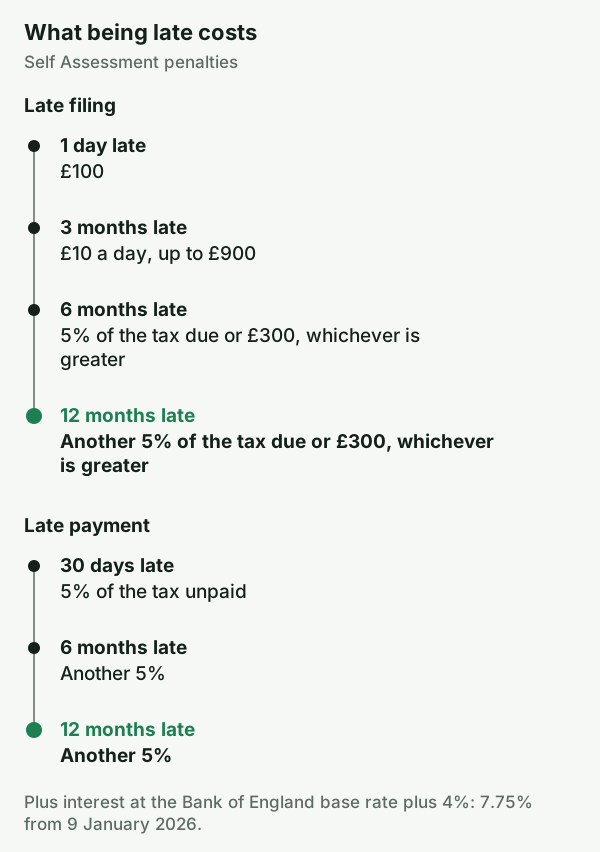
These are the penalties GOV.UK lists for a late return:
- 1 day late: an initial £100 penalty
- 3 months late: £10 a day, up to a maximum of £900
- 6 months late: a further 5% of the tax due or £300, whichever is greater
- 12 months late: another 5% of the tax due or £300, whichever is greater
Late payment penalties and interest
If the tax is not paid, HMRC charges a penalty of 5% of the tax unpaid at each of these points:
- 30 days late
- 6 months late
- 12 months late
Interest is charged on top. HMRC's late payment interest is set at the Bank of England base rate plus 4% (from 6 April 2025). GOV.UK lists the rate as 7.75% from 9 January 2026, and it changes when the base rate does.
Worked example
Alex files the 2025/26 online return on 30 April 2027, three months late, and owes £4,000. Alex pays the tax on the same day.
- Late filing: £100. The daily penalties only start after 3 months, so none apply yet.
- Late payment: 5% of £4,000 at 30 days late = £200.
- Interest: on £4,000 from 1 February to 30 April 2027, at whatever the rate is over that time. At 7.75%, roughly £75.
Alex pays about £375 on top of the £4,000 bill. Filing on time, even without the money, would have saved the £100.
If you have a reasonable excuse, you can appeal against a penalty.
What changes with Making Tax Digital for Income Tax
Making Tax Digital (MTD) for Income Tax started on 6 April 2026 for sole traders and landlords with qualifying income over £50,000 in 2024/25. Our guide do I need Making Tax Digital for Income Tax explains who else joins and when.
If you joined on 6 April 2026:
- Your 2025/26 return is a normal return. It is due by 31 January 2027, and GOV.UK confirms the current penalties above apply to it.
- Quarterly updates for 2026/27 are due by 7 August, 7 November, 7 February and 7 May (for the standard quarters ending 5 July, 5 October, 5 January and 5 April).
- Your 2026/27 return goes through MTD software by 31 January 2028.
- Payment dates do not change. GOV.UK says MTD will not change the way you pay tax or the dates payments are due.
New penalties for people in MTD
The new penalties apply from the tax year you join, so from 2026/27 for the April 2026 group.
- Late submission: one point for each missed deadline. At 4 points you get a £200 penalty, and another £200 for each missed deadline after that. There are no penalties for missing a quarterly update deadline in 2026/27.
- Late payment (2026/27): nothing if you pay within 15 days. Then 3% of the tax owed at day 15, another 3% at day 30, and from day 31 a yearly rate of 10% on what is still owed, charged daily. In your first year you get 30 days from the due date before penalties start.
- Interest is charged from the first day a payment is late, as now.
GOV.UK also says that from April 2027 the new penalties will apply to everyone who files a personal Self Assessment return, whether or not they are in MTD.
How Holdfast helps
Holdfast works out your Self Assessment from your books, box by box, so you can copy the figures into HMRC's online return (sending returns to HMRC is coming soon). It tracks HMRC deadlines with reminders, works out your payments on account and keeps a live set-aside figure, so 31 January holds no surprises. The Self Assessment deadlines help article shows where to find your dates in the app.
Questions
Is the Self Assessment deadline 31 January 2027?
Yes, for online returns for the 2025/26 tax year. The tax you owe for 2025/26 is due on the same day. Paper returns had to reach HMRC by 31 October 2026.
What if I can only pay part of my bill by 31 January?
File the return on time anyway, so you avoid the filing penalties. Late payment penalties of 5% only apply to tax still unpaid at 30 days, 6 months and 12 months, and interest runs only on what is unpaid, so paying what you can cuts both.
31 January 2027 is a Sunday. Do I get until Monday?
No. You can still file online up to 11:59pm on Sunday 31 January. For payment, GOV.UK says it should reach HMRC on the last working day before a weekend deadline, which is Friday 29 January 2027. That rule does not apply to Faster Payments or card payments.
Sources
- www.gov.uk/self-assessment-tax-returns/deadlines
- www.gov.uk/self-assessment-tax-returns/penalties
- www.gov.uk/self-assessment-tax-returns/who-must-send-a-tax-return
- www.gov.uk/register-for-self-assessment
- www.gov.uk/pay-self-assessment-tax-bill
- www.gov.uk/pay-self-assessment-tax-bill/through-your-tax-code
- www.gov.uk/understand-self-assessment-bill/payments-on-account
- www.gov.uk/government/publications/rates-and-allowances-hmrc-interest-rates-for-late-and-early-payments/rates-and-allowances-hmrc-interest-rates
- www.gov.uk/guidance/penalties-for-making-tax-digital-for-income-tax
- www.gov.uk/guidance/use-making-tax-digital-for-income-tax/submit-your-tax-return
- www.gov.uk/guidance/use-making-tax-digital-for-income-tax/send-quarterly-updates
This guide is general information, not financial, tax or legal advice. Tax rules change, so check GOV.UK or ask HMRC if you're unsure. Read our terms.
Try it and read more
- Self Assessment deadlines and key datesThe dates that matter for Self Assessment: registering, filing on paper or online, paying, and payments on account.
- Late filing and payment penaltiesWhat HMRC charges if your Self Assessment return or payment is late, how interest works, and what to do if you've missed a deadline.
- How to pay HMRCThe ways to pay your Self Assessment bill, how long each takes to reach HMRC, the right reference and what to do if you can't pay.
More tax guides
- Capital Gains Tax allowance and rates 2026/27The 2026/27 Capital Gains Tax allowance is £3,000. Gains above it are taxed at 18% or 24%, property included, and UK residential gains are due within 60 days.
- High Income Child Benefit Charge explainedThe High Income Child Benefit Charge takes back 1% of Child Benefit for every £200 of adjusted net income over £60,000, and all of it once you reach £80,000.
- HMRC scam emails, texts and calls: how to spot and report themForward HMRC scam emails to phishing@hmrc.gov.uk and scam texts to 60599. HMRC never threatens arrest, asks for gift vouchers or offers refunds on social media.
- HMRC Time to Pay: Self Assessment payment plansIf you cannot pay your Self Assessment bill, you may be able to set up an HMRC payment plan (Time to Pay) online or by phone. Interest is still charged.