Director's loan accounts and s455 tax explained
If you owe your company money 9 months after its year end, it pays s455 tax at 35.75% on loans made from 6 April 2026. How it works and how to avoid it.
If you owe your company money at the end of its accounting year and haven't paid it back within 9 months, the company pays extra corporation tax on what is still owed, called s455 tax. For loans made on or after 6 April 2026 the rate is 35.75%. The tax is refundable once the loan is repaid, but it can tie up a lot of cash in the meantime.
This guide explains how a director's loan account works, how s455 is worked out, the extra rules over £10,000, and the ways to clear an overdrawn account.
What a director's loan is
GOV.UK defines a director's loan as money you, or close family, get from your company that is not:
- salary
- a dividend
- an expense repayment
- money you previously paid into or lent the company
The director's loan account is the running record of money going both ways between you and the company. You must keep it, and whatever is owed at the year end goes on the balance sheet in the company's annual accounts.
It is "overdrawn" when you owe the company, and "in credit" when the company owes you.
How accounts go overdrawn without anyone noticing
Common causes in one-person companies:
- paying personal bills from the business account or card
- taking regular "drawings" during the year and planning to sort out dividends later
- paying a dividend that turns out to be more than the company's available profits
The 9-month rule and s455
At the end of each accounting period, look at what you owe the company. You then have 9 months from the year end to repay it.
- Repaid in time: no s455 tax. The company still shows the loan on form CT600A with its Company Tax Return.
- Not repaid in time: the company pays s455 tax on what is still owed, plus interest until it is paid or the loan is repaid.
s455 tax is due 9 months and 1 day after the end of the accounting period, the same date as the corporation tax for that period.
The rates
The rate depends on when the loan was made. Since 6 April 2016 it has been tied to the higher rate of dividend tax.
| Loan made | s455 rate |
|---|---|
| On or after 6 April 2026 | 35.75% |
| 6 April 2022 to 5 April 2026 | 33.75% |
| 6 April 2016 to 5 April 2022 | 32.5% |
| Before 6 April 2016 | 25% |
The 35.75% rate was set at Budget 2025. HMRC says its online Corporation Tax service will be updated on 6 April 2027. If the new rate applies to your company and you file before then, you will need to amend your return after 6 April 2027.
Getting s455 back
s455 is not lost. Once the loan is repaid, written off or released, the company can claim the tax back. But it can only claim from 9 months and 1 day after the end of the accounting period in which the loan was repaid, and must claim within 4 years. Interest is not refunded.
Worked example
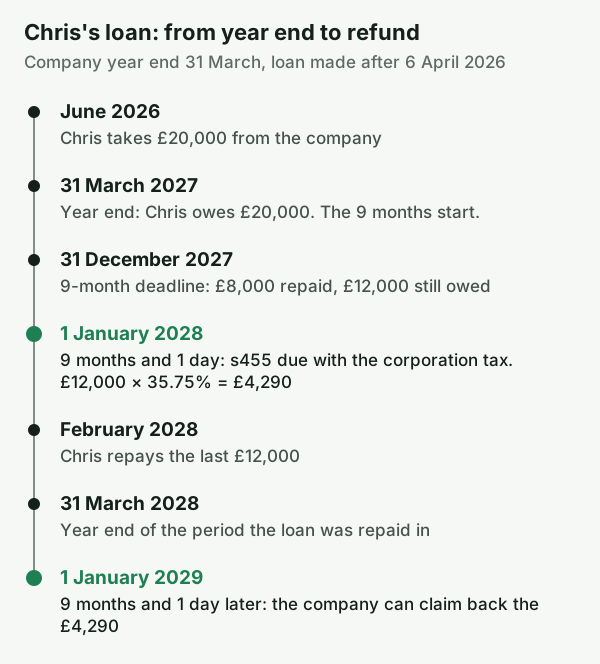
Chris's company has a year end of 31 March 2027. In June 2026 Chris takes £20,000 from the company that isn't salary or dividends.
- At 31 March 2027 Chris owes £20,000. The 9-month deadline is 31 December 2027.
- By then Chris has repaid £8,000, leaving £12,000 owed.
- s455 tax: £12,000 × 35.75% = £4,290, due on 1 January 2028 with the corporation tax.
Chris repays the last £12,000 in February 2028. That is in the company's next accounting period, which ends 31 March 2028. The company can claim back the £4,290 from 1 January 2029.
Because Chris owed more than £10,000 during the year, there is also a benefit in kind to deal with (see below).
You can work through your own figures with the director's loan s455 calculator.
Loans over £10,000
If you owe the company more than £10,000 at any time in the year, the company must treat the loan as a benefit in kind. National Insurance is due through the company, and you report the loan on your Self Assessment return (see Self Assessment for company directors). You may also have to pay tax worked out using HMRC's official rate of interest, and any interest you pay the company below that rate is recorded as company income.
Repaying and reborrowing
You can't clear the balance just before the deadline and take it straight back out. GOV.UK says s455 still applies if:
- the loan was over £5,000 and you took another loan of £5,000 or more within 30 days before or after repaying it, or
- the loan was over £15,000 and you arranged another loan when you repaid it
This is often called "bed and breakfasting".
Ways to clear an overdrawn account
- Repay it in cash from your own money.
- Declare a dividend and credit it to your loan account. This needs enough available profits, board minutes and a voucher, and the dividend is taxed on you as normal.
- Pay a salary or bonus through payroll and credit it to the account. Income Tax and National Insurance apply.
- Write it off. The company deducts National Insurance through payroll and you pay Income Tax on the amount through Self Assessment.
Which works best depends on your profits and your other income. Our guide to salary vs dividends shows how each is taxed.
When the company owes you
If you have paid business costs from your own money or put cash into the company, the account is in credit. The company doesn't pay corporation tax on money you lend it, and when it pays that money back to you it is not salary or a dividend, so there is no tax on the repayment itself.
If the company pays you interest on your loan, it is a business expense for the company and personal income for you. The company pays you the interest less 20% Income Tax, and reports and pays that tax to HMRC every quarter on form CT61. You report the interest on your Self Assessment return.
How Holdfast helps
Holdfast keeps your director's loan account up to date as you categorise payments, so personal spending on the company card lands in the right place. It shows what you owe at the year end, the 9-month repayment date and the s455 that would be due, and it creates dividend vouchers and minutes if you clear the balance with a dividend. See your director's loan and s455.
Questions
What is the s455 tax rate for 2026/27?
35.75% for loans made on or after 6 April 2026. It is 33.75% for loans made from 6 April 2022 to 5 April 2026, and 32.5% for loans made from 6 April 2016 to 5 April 2022.
Do I get s455 tax back?
Yes, once the loan is repaid, written off or released. The company can claim from 9 months and 1 day after the end of the accounting period in which that happened, and must claim within 4 years. Interest charged on late s455 is not refunded.
Is an overdrawn director's loan illegal?
No. Directors can borrow from their company. It just has tax consequences if it isn't cleared within 9 months of the year end or goes over £10,000.
Sources
- www.gov.uk/directors-loans
- www.gov.uk/directors-loans/you-owe-your-company-money
- www.gov.uk/directors-loans/you-lend-your-company-money
- www.gov.uk/hmrc-internal-manuals/company-taxation-manual/ctm61505
- www.gov.uk/hmrc-internal-manuals/company-taxation-manual/ctm61600
- www.gov.uk/hmrc-internal-manuals/company-taxation-manual/ctm98210
- www.gov.uk/guidance/changes-and-issues-affecting-the-corporation-tax-online-service
- www.gov.uk/running-a-limited-company/taking-money-out-of-a-limited-company
This guide is general information, not financial, tax or legal advice. Tax rules change, so check GOV.UK or ask HMRC if you're unsure. Read our terms.
Try it and read more
- Director's loan s455 tax calculatorFree calculator
- Your director's loan and s455Money you take from your company that isn't salary or dividends goes on your director's loan. Holdfast tracks it and the deadline to repay.
- Corporation tax and your CT600Holdfast works out your company's corporation tax and prepares the CT600 return, with the dates to pay and file.
- Doing your year endHoldfast turns your bank-based books into year-end accounts, with a to-do list where each step has one-tap answers.
More limited companies guides
- Companies House late filing penaltiesLate accounts cost a private company £150 to £1,500 depending on how late, doubled if late two years running. Deadlines, the full table and how appeals work.
- Corporation tax deadlines and the CT600 returnPay corporation tax 9 months and 1 day after your accounting period ends and file the CT600 within 12 months. Penalties start at £200 and interest runs daily.
- Corporation tax rates and marginal relief explainedCorporation tax is 19% on profits up to £50,000 and 25% over £250,000. In between, marginal relief applies. Here is how it works, with the maths shown.
- Dormant company accounts and telling HMRCA dormant company still files accounts and a confirmation statement at Companies House every year. HMRC and Companies House define dormant differently.