Do I need Making Tax Digital for Income Tax?
Who has to use Making Tax Digital for Income Tax, when you start (2026, 2027 or 2028), how qualifying income is worked out, and what you must send HMRC.
You need Making Tax Digital (MTD) for Income Tax if you are a sole trader or landlord and your self-employment and property income, added together and before expenses, is over the threshold. It started on 6 April 2026 for people with more than £50,000, starts on 6 April 2027 for more than £30,000, and on 6 April 2028 for more than £20,000.
Under MTD you keep digital records, send HMRC a short update every quarter, and file your tax return through software instead of HMRC's online form.
If you started on 6 April 2026, you still file your 2025/26 tax return the usual way by 31 January 2027. Your quarterly updates are for 2026/27, so they don't replace it.
Who has to use it
GOV.UK says you need MTD for Income Tax if all of these apply. You are:
- a sole trader or landlord registered for Self Assessment
- getting self-employment income, property income, or both
- over the qualifying income threshold for the relevant tax year
It does not apply to limited companies. Partnerships will come in later, on a timeline HMRC has not yet set.
When you start
Each start date is decided by your qualifying income in an earlier tax year, using the Self Assessment return you filed for that year.
| Qualifying income in... | Over... | You start on... |
|---|---|---|
| 2024/25 | £50,000 | 6 April 2026 |
| 2025/26 | £30,000 | 6 April 2027 |
| 2026/27 | £20,000 | 6 April 2028 |
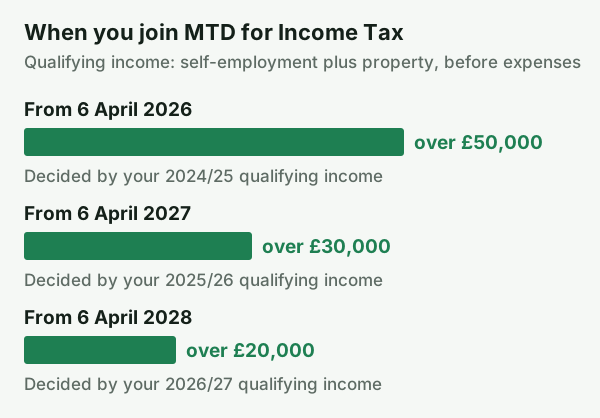
HMRC reviews your return each year and writes to you if you have to start. Don't wait for the letter though: check your own figures. If you were over £50,000 in 2024/25 and have not signed up yet, you can still sign up now.
How qualifying income is worked out
This is the part people get wrong. Qualifying income is your gross income, meaning before expenses (HMRC calls it turnover), from:
- self-employment (every sole trader business you run, added together)
- UK property, and foreign property if you are UK tax resident
If you own a property jointly, only your share of the rent counts. For example, a £50,000 rental split equally counts as £25,000 for each owner.
These do not count towards the threshold:
- salary from a job (PAYE)
- dividends, including from your own company
- your share of partnership profit
- State Pension and private pensions
You still report these on your tax return. They just don't decide whether you need MTD.
What you have to do
1. Keep digital records
Record your self-employment and property income and expenses in software. Spreadsheets are allowed if you use bridging software to connect them to HMRC. GOV.UK lists software that has been through HMRC's recognition process, and says free products exist for simple tax affairs.
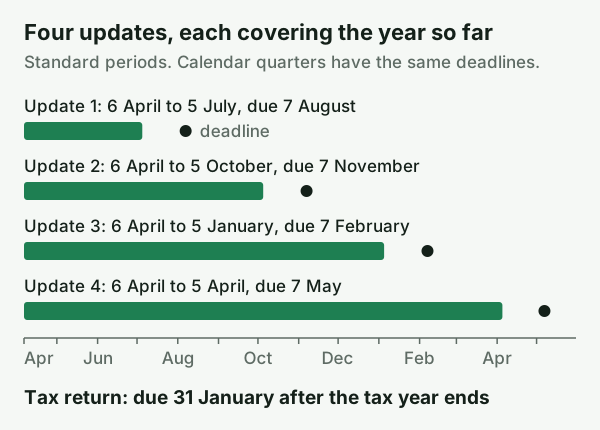
2. Send four quarterly updates
Each update covers the tax year so far and contains totals for each income and expense category. HMRC does not receive individual receipts or invoices.
| Period (standard) | Deadline |
|---|---|
| 6 April to 5 July | 7 August |
| 6 April to 5 October | 7 November |
| 6 April to 5 January | 7 February |
| 6 April to 5 April | 7 May (the following tax year) |
You can choose calendar quarters (ending 30 June, 30 September, 31 December and 31 March) instead. The deadlines are the same.
Because each update is cumulative, you can correct mistakes in the next one.
3. File your tax return through software
Your tax return is due by 31 January after the end of the tax year, as now. GOV.UK says MTD "will not change the way you pay tax or the dates that payments are due". Our guide to Self Assessment deadlines lists every date.
Penalties
MTD uses a points system for late submissions. You get a point for each missed deadline. At 4 points you get a £200 penalty, and another £200 for each deadline missed after that.
There is a soft landing for the first year: there are no penalties for missing a quarterly update deadline in the 2026/27 tax year. You still have to send all four updates before you can file your tax return.
Late payment penalties start at 3% of the tax owed at day 15, and another 3% at day 30, plus interest, for 2026/27. In your first year under the new rules you get 30 days before late payment penalties start.
Worked example
Jo is a freelance designer and co-owns a rental flat with her partner. In 2025/26:
- Freelance sales: £18,000 (costs of £4,000)
- Rent from the flat: £28,000, split equally, so Jo's share is £14,000
- Jo also earns £10,000 of dividends from a small company she part-owns
Jo's qualifying income is £18,000 + £14,000 = £32,000. Her costs don't reduce it, and the dividends don't count. That is over £30,000, so Jo must use MTD for Income Tax from 6 April 2027.
Her first year, 2027/28, looks like this:
- Quarterly updates due 7 August 2027, 7 November 2027, 7 February 2028 and 7 May 2028
- Tax return due 31 January 2029
Her partner has only the £14,000 rental share and a salary, so their qualifying income is £14,000. They do not need MTD yet, although the £20,000 threshold from April 2028 is worth keeping an eye on.
You can see roughly what you'll owe on your profit with the sole trader take-home calculator.
Exemptions
Some people are exempt, for example if they are digitally excluded, meaning they can't reasonably use software to keep records and send updates. A few people are exempt automatically. Everyone else has to apply by phoning or writing to HMRC's Self Assessment helpline, so don't assume you are exempt without hearing back. Exempt people still file a normal Self Assessment return.
If you're already in MTD
If you started on 6 April 2026, your second quarterly update (6 April to 5 October) is due by 7 November 2026. Missing it this year won't bring a penalty point, but you will need to send it before filing your 2026/27 tax return.
How Holdfast helps
Holdfast keeps your income and expenses as digital records, sorts them into HMRC's categories with Keeper, and works out your MTD quarterly totals and Self Assessment figures as you go. Sending returns straight to HMRC from Holdfast is coming soon; until then you can take those figures into HMRC-recognised bridging software. The Making Tax Digital for Income Tax help article covers the setup.
Questions
Is the Making Tax Digital threshold based on profit or turnover?
Turnover. HMRC uses your self-employment and property income before expenses, added together. A sole trader with £35,000 of sales and £20,000 of costs still has £35,000 of qualifying income.
Do I need Making Tax Digital if I only have a limited company?
Not for your company. MTD for Income Tax is for sole traders and landlords. Salary and dividends from your own company do not count towards the threshold.
Do I still file a tax return under Making Tax Digital?
Yes. You send four quarterly updates and then a tax return through your software by 31 January after the end of the tax year. Payment dates do not change.
I started Making Tax Digital in April 2026. Do I still file my 2025/26 tax return?
Yes, the usual way, by 31 January 2027. Your quarterly updates for 2026/27 are summaries of that year, so they do not replace your 2025/26 return.
Sources
- www.gov.uk/guidance/check-if-youre-eligible-for-making-tax-digital-for-income-tax
- www.gov.uk/guidance/work-out-your-qualifying-income-for-making-tax-digital-for-income-tax
- www.gov.uk/guidance/use-making-tax-digital-for-income-tax/send-quarterly-updates
- www.gov.uk/guidance/use-making-tax-digital-for-income-tax/submit-your-tax-return
- www.gov.uk/guidance/penalties-for-making-tax-digital-for-income-tax
- www.gov.uk/guidance/choose-the-right-software-for-making-tax-digital-for-income-tax
- www.gov.uk/guidance/apply-for-an-exemption-from-making-tax-digital-for-income-tax
- www.gov.uk/guidance/find-out-if-and-when-you-need-to-use-making-tax-digital-for-income-tax
- www.gov.uk/self-assessment-tax-returns/deadlines
This guide is general information, not financial, tax or legal advice. Tax rules change, so check GOV.UK or ask HMRC if you're unsure. Read our terms.
Try it and read more
- Sole trader take-home pay calculator 2026/27Free calculator
- Making Tax Digital for Income TaxWho has to use Making Tax Digital for Income Tax, when it starts for you, what quarterly updates are, and how Holdfast helps.
- Keeping records for HMRCWhat records HMRC expects you to keep for Self Assessment, how long to keep them, and how Holdfast keeps them for you.
- Rental income and landlord expensesWhen rent needs reporting to HMRC, which costs you can claim, how mortgage interest works, and how Holdfast's Property tax page works it out.
More making tax digital guides
- Making Tax Digital quarterly updates and deadlinesMTD for Income Tax quarterly updates are due 7 August, 7 November, 7 February and 7 May, each covering the year so far. Tax return due 31 January.
- Who is exempt from Making Tax Digital for Income Tax?You don't need MTD for Income Tax yet if qualifying income is under your year's threshold, or you're exempt, for example digitally excluded. Full list.