How creators and influencers pay tax in the UK
UK creators pay tax on ad revenue, brand deals and gifted products. When to tell HMRC, how gifts are valued, and when a limited company makes sense.
UK content creators pay Income Tax and National Insurance on their profit from ad revenue, brand deals, affiliate income and gifted products, just like any other self-employed person. If your total income from creating content and any other side hustles is more than £1,000 in a tax year, you will usually need to register for Self Assessment and file a tax return.
This guide covers what counts as income, how gifts are valued, the deadlines, and when a limited company is worth a look.
What counts as income
HMRC's guidance on online platforms says income from creating online content (videos, podcasts, social media influencing) includes:
- money from brands for posts, videos or reviews
- ad revenue and platform payouts
- affiliate commission
- gifts and services you receive from promoting products online
If you also sell goods or services, that income is added to your content income. All of it counts towards the same totals.
How gifts are valued
When you're given something instead of money, GOV.UK says to use "the value of what it would have cost if you had to pay for them". So a £400 camera sent in exchange for a review counts as £400 of income.
The guidance is about gifts received for promoting products, so keep a simple log of every gifted item: what it was, who sent it, what it would have cost, and what you agreed to post.
The £1,000 trading allowance
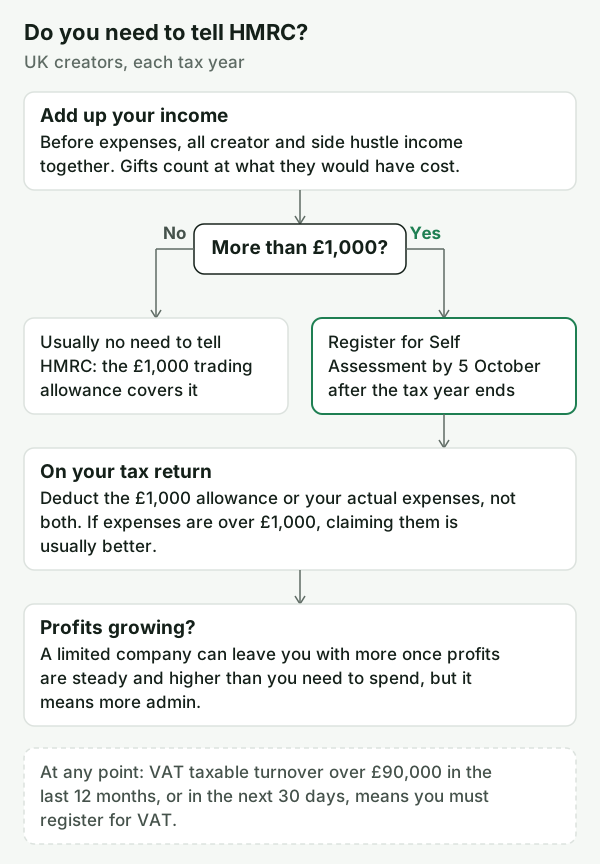
You get a £1,000 trading allowance each tax year. It covers all your trading income combined, not £1,000 per platform or per side hustle.
- Income of £1,000 or less: you usually don't need to tell HMRC about it.
- Income over £1,000: register for Self Assessment by 5 October after the end of the tax year.
The test uses income before expenses. HMRC's example: £700 from brands for review videos, plus gifted products worth £300, plus £200 of ad revenue, totals £1,200. That creator needs to tell HMRC.
When you file, you can either deduct the £1,000 allowance or deduct your actual expenses, not both. If your expenses are more than £1,000, claiming them is usually better. You can't use the allowance against income from a company you own or control. Our guide to the £1,000 trading allowance goes into more detail.
Expenses you can claim
You only pay tax on profit. Allowable expenses are business costs, not money taken for personal use. If something is used both personally and for the channel, such as a phone, claim only the business part.
Typical creator costs include equipment and software, editing and subcontractor costs, travel for shoots, website and advertising costs, phone and internet (business share), and training. GOV.UK lists clothing such as uniforms as allowable but says nothing about everyday clothes, so be cautious about claiming outfits you would also wear normally. See what expenses you can claim as a sole trader for the full list.
What you'll pay as a sole trader
For 2026/27 (England, Wales and Northern Ireland):
- Income Tax: 0% on the first £12,570 of your total income, 20% on the next £37,700, 40% above that.
- Class 4 National Insurance: 6% on profits between £12,570 and £50,270, and 2% above.
- Class 2 National Insurance: you don't have to pay it if your profits are £7,105 or more. Below that you can choose to pay it voluntarily, at £3.65 a week in 2026/27.
Remember that a salary from a job uses your personal allowance first, so creator profit on top of a job is often taxed at 20% from the first pound.
Worked example
Mia is a full-time creator with no other job. In 2026/27 she has:
| Income | Amount |
|---|---|
| Ad revenue | £20,000 |
| Brand deals | £12,000 |
| Gifted products in exchange for posts | £3,000 |
| Total income | £35,000 |
| Expenses (camera kit, editing, travel) | £5,000 |
| Profit | £30,000 |
Her tax:
- Income Tax: (£30,000 − £12,570) × 20% = £3,486
- Class 4 NI: (£30,000 − £12,570) × 6% = £1,045.80
- Total: £4,531.80
Mia files her 2026/27 return and pays by 31 January 2028. Because her bill is over £1,000, she will usually also have to make payments on account towards the next year: two payments, each usually half of last year's bill, due 31 January and 31 July. Her first January payment can come as a shock, so it is worth putting money aside from every brand deal.
Note the £3,000 of gifts. Mia never received that as cash, but she pays tax on it all the same.
Try your own numbers with the sole trader take-home calculator.
Sole trader or limited company?
Starting as a sole trader is the simplest route. There is no company to run and one tax return a year.
A limited company is a separate legal entity. It pays corporation tax on its profit (19% on profits up to £50,000, 25% over £250,000, and in between with marginal relief). You then pay yourself a salary and dividends. Dividends above the £500 allowance are taxed at 10.75% in the basic rate band and 35.75% in the higher rate band in 2026/27, with no National Insurance.
A company can leave you with more after tax once profits are steady and higher than you need to spend each year, because you can leave money in the company. The trade-off is more admin: payroll, annual accounts, a corporation tax return, a confirmation statement, and your own Self Assessment for dividends. Our guide to salary vs dividends shows how directors pay themselves.
VAT
VAT is separate from Income Tax. You must register if your VAT taxable turnover for the last 12 months goes over £90,000, or will in the next 30 days. See our guide to the VAT threshold and when to register.
How Holdfast helps
Holdfast tracks each brand deal from agreed to paid, logs gifted products alongside cash income, and works out your profit, Income Tax, NI and Self Assessment figures as you go. Keeper sorts your spending into expense categories, and you can send receipts by WhatsApp. See tracking brand deals.
Questions
Do influencers pay tax on gifted products?
Yes, when the gifts come from promoting products. HMRC counts gifts and services you receive from promoting products online as income, valued at what they would have cost you to buy.
How much can I earn as a content creator before telling HMRC?
£1,000 in a tax year (6 April to 5 April), across all your side income combined, including the value of gifts. Over that, you will usually need to register for Self Assessment.
Should a content creator set up a limited company?
It can save tax once profits are steady and well above what you need to live on, but it adds payroll, accounts and Companies House filings. You can start as a sole trader and switch later.
Sources
- www.gov.uk/guidance/check-if-you-need-to-tell-hmrc-about-your-income-from-online-platforms
- taxhelpforhustles.campaign.gov.uk/tax-rules-content-creators/
- www.gov.uk/guidance/tax-free-allowances-on-property-and-trading-income
- www.gov.uk/self-assessment-tax-returns/deadlines
- www.gov.uk/understand-self-assessment-bill/payments-on-account
- www.gov.uk/self-employed-national-insurance-rates
- www.gov.uk/government/publications/rates-and-allowances-income-tax/income-tax-rates-and-allowances-current-and-past
- www.gov.uk/expenses-if-youre-self-employed
- www.gov.uk/register-for-vat
- www.gov.uk/corporation-tax-rates
- www.gov.uk/tax-on-dividends
This guide is general information, not financial, tax or legal advice. Tax rules change, so check GOV.UK or ask HMRC if you're unsure. Read our terms.
Try it and read more
- Sole trader take-home pay calculator 2026/27Free calculator
- Tracking brand dealsKeep every brand deal from agreed to paid, add one from a photo or message, see agency commission, and spot late payers.
- Do I need to file a Self Assessment return?Who has to send HMRC a Self Assessment return, the income that can mean you need one, and how to register by 5 October.
- Allowable expenses for the self-employedWhat business costs you can claim to lower your tax, what you can't, and how Holdfast sorts your payments into the right boxes.
More creators guides
- Do influencers pay tax on gifted products?Yes. HMRC counts gifts and free services you get for promoting products as income, valued at what they'd have cost to buy. How to value, log and report them.
- Tax on YouTube and TikTok income in the UKUK creators pay Income Tax and National Insurance on YouTube ad revenue and TikTok payouts. Register once income tops £1,000 a year, then claim your expenses.