The VAT threshold and when you must register
You must register for VAT when your taxable turnover for the last 12 months goes over £90,000, or will in the next 30 days. Deadlines and examples here.
You must register for VAT if your VAT taxable turnover for the last 12 months goes over £90,000, or if you expect it to go over £90,000 in the next 30 days alone. The 12 months are rolling, not a tax year, so check at the end of every month.
This guide explains both tests, the deadlines, what counts as taxable turnover, and what to do while you wait for your VAT number.
The two tests
1. The rolling 12-month test (looking back)
At the end of each month, add up your VAT taxable turnover for the previous 12 months. If the total is over £90,000:
- Deadline: register within 30 days of the end of the month when you went over.
- Effective date: your VAT registration starts on the first day of the second month after you went over. From that date you must charge VAT.
2. The 30-day test (looking forward)
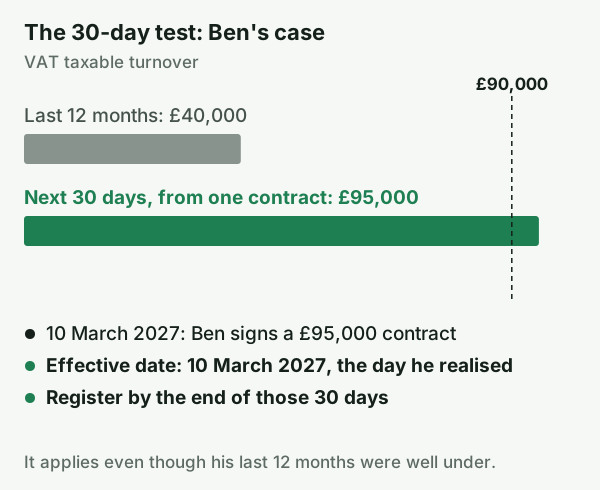
If at any point you realise your turnover will go over £90,000 in the next 30 days on its own, for example because you have won one large contract:
- Deadline: register by the end of that 30-day period.
- Effective date: the date you realised, not the date your turnover actually goes over.
This test is easy to miss. It applies even if your last 12 months were well under the threshold.
What counts as VAT taxable turnover
GOV.UK defines taxable turnover as the total value of everything you sell that is not VAT exempt or "out of scope". It includes:
- standard-rated, reduced-rated and zero-rated sales (zero-rated still counts, even though you charge 0%)
- goods you hire or lend to customers
- business goods used for personal reasons
It is sales, not profit. Your costs make no difference to the threshold.
Exempt sales (things the law says carry no VAT at all) and out-of-scope income don't count towards it.
Worked example
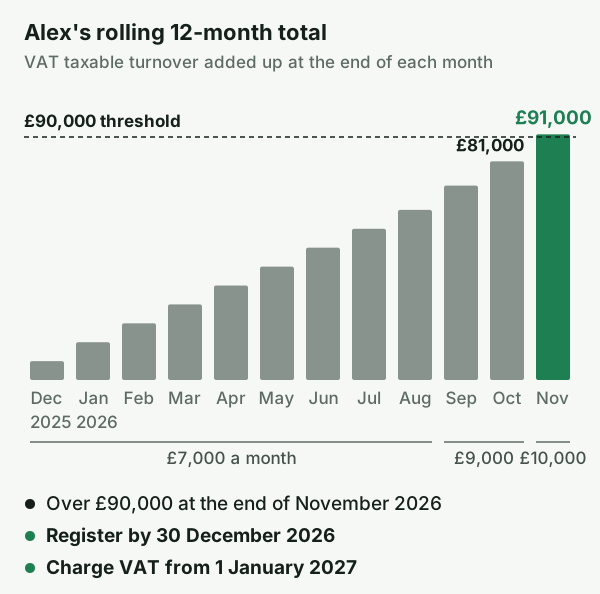
Alex is a freelance consultant who started in December 2025. Her monthly invoices were:
| Months | Per month | Total |
|---|---|---|
| December 2025 to August 2026 (9 months) | £7,000 | £63,000 |
| September and October 2026 | £9,000 | £18,000 |
| November 2026 | £10,000 | £10,000 |
- At the end of October 2026, her 12-month total is £81,000. Under the threshold.
- At the end of November 2026, it is £91,000. Over.
So Alex must:
- register by 30 December 2026 (30 days after the end of November)
- charge VAT from 1 January 2027 (the first day of the second month after November)
Now a different case. Ben's last 12 months total £40,000. On 10 March 2027 he signs a £95,000 contract that he will invoice within the next 30 days. That single contract takes him over £90,000 in the next 30 days, so the 30-day test applies. Ben must register by the end of that 30-day period, and his effective date is 10 March 2027.
You can check your own rolling total with the VAT threshold checker.
While you wait for your VAT number
Registration is usually done online. Your VAT number comes by post, and there can be a gap between your effective date and getting it.
During that gap:
- Don't show VAT on invoices. GOV.UK says you cannot include VAT on your invoices until you get your VAT registration number.
- You can raise your prices to cover the VAT you will owe. Once your number arrives, reissue those invoices showing the VAT. GOV.UK's example is a £100,000 contract invoiced at £120,000, then reissued with the VAT shown once the number arrives.
- You can reclaim VAT on things you buy for the business from your effective date.
You owe HMRC VAT on your sales from the effective date, whether or not you have charged it, so act as soon as you know you are over.
If you register late
You still have to account for VAT from the date you should have been registered. If you didn't charge it, it usually comes out of your own pocket. HMRC can also charge a penalty for failing to tell them, worked out from the VAT due from the date you should have registered. Tracking the rolling total every month is far cheaper than fixing this afterwards.
Voluntary registration
You can choose to register even if your turnover is under £90,000. It can help if:
- most of your customers are VAT-registered businesses, who can reclaim the VAT you charge
- you buy a lot of things with VAT on them, which you could then reclaim
It is usually less helpful if you sell mainly to the public, because your prices go up or your margin goes down. Once registered you must charge VAT, keep VAT records and file VAT returns. The VAT schemes help article covers options that can simplify this.
Leaving VAT
If your taxable turnover falls below £88,000, you can ask HMRC to cancel your registration. That is lower than the £90,000 registration threshold, so a business hovering just under £90,000 can't drop out straight away.
Businesses based outside the UK
If you and your business are based outside the UK and you supply goods or services to the UK (or expect to in the next 30 days), you must register whatever your turnover. The £90,000 threshold doesn't help you.
How Holdfast helps
Holdfast adds up your taxable sales over the last 12 months as you invoice and warns you as you get close to £90,000, so you see the register-by date before it passes. Once you're registered it works out your VAT returns from your books. Sending returns to HMRC from Holdfast is coming soon; until then you can export a CSV into bridging software. See tracking the VAT threshold.
Questions
Is the VAT threshold based on profit or turnover?
Turnover. It is the total value of your VAT taxable sales, before any costs. A business with £95,000 of sales and £60,000 of costs is over the threshold.
Is the VAT threshold per tax year?
No. It is any rolling 12-month period. You check at the end of every month by adding up the last 12 months of taxable sales.
Can I register for VAT if I'm under £90,000?
Yes. This is called voluntary registration. It can make sense if your customers are VAT-registered businesses or you buy a lot of VAT-able goods, but you then have to charge VAT and file returns.
Sources
This guide is general information, not financial, tax or legal advice. Tax rules change, so check GOV.UK or ask HMRC if you're unsure. Read our terms.
Try it and read more
- VAT threshold checkerFree calculator
- Tracking the VAT thresholdHoldfast watches your taxable sales over the last 12 months and tells you when you're getting close to the £90,000 VAT threshold.
- Registering for VATHow to register for VAT with HMRC, what happens next, and how to set Holdfast up once you have your VAT number.
- VAT schemes: flat rate, cash and annual accountingThe three main VAT schemes for small businesses, who can use them, and how Holdfast works out your return on each.
More vat guides
- How to deregister for VATYou can cancel VAT registration if taxable turnover will be under £88,000 in the next 12 months, and must within 30 days if you stop being eligible.
- Reclaiming VAT on things you bought before registeringYou can reclaim VAT on goods bought up to 4 years before VAT registration if you still have them, and on services from up to 6 months before. Rules and example.
- The VAT Cash Accounting Scheme explainedWith VAT cash accounting you pay VAT on sales when customers pay you. Join at £1.35 million turnover or less; leave once it goes over £1.6 million.
- The VAT Flat Rate Scheme explainedOn the VAT Flat Rate Scheme you pay a fixed % of VAT-inclusive turnover. Join at £150,000 or less, leave over £230,000. Low goods spend means 16.5%.