How much salary should a director take in 2026/27?
For most one-person limited companies in 2026/27, a £12,570 salary with the rest as dividends works out best. Here is why, with the sums worked through.
For most one-person limited companies in 2026/27, the best director salary is £12,570 a year (HMRC's monthly payroll threshold is £1,048), with the rest taken as dividends. That salary is free of Income Tax and employee National Insurance for you, and even after the company pays employer's National Insurance on it, the corporation tax it saves makes it cheaper than taking the same money as dividends.
This guide explains why, when a lower salary makes sense, and what changes if your company can claim Employment Allowance. It uses rates for England, Wales and Northern Ireland.
The numbers that matter for 2026/27
These come from HMRC's rates for the tax year 6 April 2026 to 5 April 2027.
| Threshold | Per year | What it means |
|---|---|---|
| Secondary threshold | £5,000 | Employer's NI (15%) starts above this |
| Lower earnings limit | £6,708 | Pay at this level can count towards your State Pension |
| Primary threshold | £12,570 | Employee NI (8%) starts above this |
| Personal allowance | £12,570 | Income Tax starts above this |
| Employment Allowance | £10,500 | Reduces employer's NI, if you are eligible |
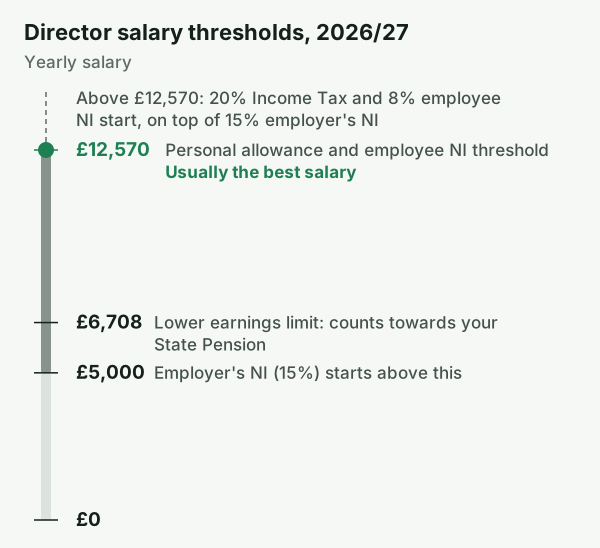
Dividends above the £500 dividend allowance are taxed at 10.75% in the basic rate band and 35.75% in the higher rate band in 2026/27. Both rates went up by 2 percentage points on 6 April 2026, so advice written for 2025/26 now gives the wrong answer in places.
Corporation tax is 19% on profits of £50,000 or less and 25% on profits over £250,000, with marginal relief in between.
Why £12,570 usually wins
Salary is a business cost, so it cuts the company's corporation tax. Employer's NI on that salary is also a business cost. Dividends are paid out of profit that has already had corporation tax taken off.
So the question is: does the corporation tax saved by paying salary outweigh the employer's NI it costs? Between £5,000 and £12,570, it does.
Take the slice of salary between £6,708 and £12,570. That is £5,862 of extra salary.
- Employer's NI on it: £5,862 × 15% = £879.30
- Total cost to the company: £6,741.30, all deductible for corporation tax
- What you receive: £5,862, with no Income Tax or employee NI
Now suppose the company kept that £6,741.30 as profit instead and paid it to you as a dividend.
- Corporation tax at 19%: £1,280.85
- Dividend paid: £5,460.45 (tax-free for you, because your unused personal allowance covers it)
Salary puts about £400 more in your pocket. At the 25% corporation tax rate the gap is bigger, because the salary saves more tax.
Above £12,570, dividends win
Once salary goes over £12,570, you start paying 20% Income Tax and 8% employee NI, on top of the company's 15%. For every £100 the company spends:
- As salary: about £62.61 reaches you
- As a dividend (19% corporation tax, basic rate): about £72.29 reaches you
- As a dividend (25% corporation tax, basic rate): about £66.94 reaches you
That is why most directors stop salary at £12,570 and take the rest as dividends. For the full comparison, including the higher rate band, see our guide to salary vs dividends.
Worked example
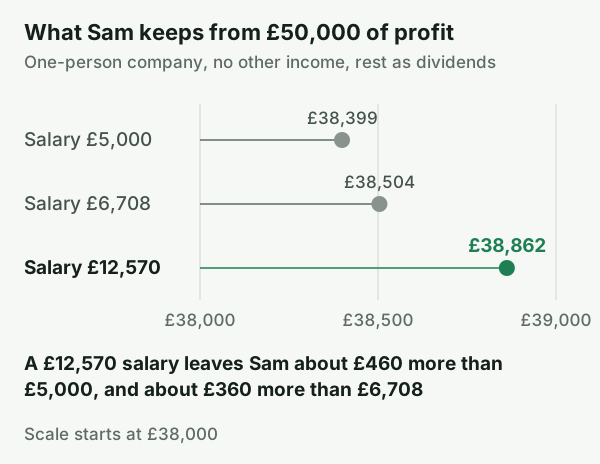
Sam runs a one-person limited company. Profit before Sam's pay is £50,000. Sam has no other income and the company cannot claim Employment Allowance. Sam takes everything that is left as dividends.
| Salary £5,000 | Salary £6,708 | Salary £12,570 | |
|---|---|---|---|
| Employer's NI | £0 | £256 | £1,136 |
| Profit after pay and NI | £45,000 | £43,036 | £36,295 |
| Corporation tax (19%) | £8,550 | £8,177 | £6,896 |
| Dividends paid | £36,450 | £34,859 | £29,399 |
| Dividend tax | £3,051 | £3,063 | £3,107 |
| Sam keeps in total | £38,399 | £38,504 | £38,862 |
The £12,570 salary leaves Sam about £460 better off than £5,000, and about £360 better off than £6,708. Figures are rounded to the nearest pound.
You can try your own figures in the salary vs dividends calculator.
When a lower salary can make sense
You have another job or pension income
If you are already using your personal allowance elsewhere, director salary is taxed at 20% from the first pound and employee NI may apply. In that case a salary of up to £5,000 (no employer's NI) or £6,708 is often the better choice. Check what your other income already uses.
The company is making a loss or very little profit
Salary only saves corporation tax if there is profit to save it on. If the company has no profit, employer's NI above £5,000 is a pure cost. Some directors pay £5,000 in a quiet year, or the £6,708 lower earnings limit so the year can still count towards their State Pension. GOV.UK says that on earnings in this band "you do not usually pay National Insurance but may still qualify for certain benefits and the State Pension".
If your company can claim Employment Allowance
Employment Allowance cuts employer's NI by up to £10,500 a year. But a company cannot claim it if its only director is the only employee liable for employer's NI. So a true one-person company usually cannot.
If you can claim it (for example, you employ someone else or there are two directors on the payroll), employer's NI on a £12,570 salary is covered and the case for £12,570 gets stronger. Salary above £12,570 then costs you 28% (20% tax plus 8% NI) with no employer's NI. That is close to the dividend route at the 19% corporation tax rate, and better than it at 25%. The sums are close enough that it is worth running your own figures.
Things to set up before you pay yourself
- Register the company as an employer with HMRC and run payroll. Salary must go through payroll with a report to HMRC each time you pay.
- Minimum wage: GOV.UK lists company directors among those not entitled to the National Minimum Wage, so a £12,570 salary is allowed. If you also have an employment contract with your company, check whether that changes things.
- Dividends need profit and paperwork. You can only pay dividends from available profits, and each one needs board minutes and a dividend voucher.
- Tax on dividends above £500 is paid through Self Assessment, so you will need to file a return. For 2026/27 that is due by 31 January 2028. See do company directors need to do a Self Assessment?
How Holdfast helps
Holdfast runs your director's payroll and works out the employer's NI, then tracks your company's profit so you can see what is available for dividends. It creates dividend vouchers and board minutes, and works out your corporation tax and personal Self Assessment figures from the same books. The running payroll help article shows how to set up a director's salary.
Questions
Is £12,570 the best director salary for 2026/27?
For a company where the director is the only employee and has no other income, yes in most cases. The salary is tax-free for you, and the corporation tax it saves is more than the employer's National Insurance it costs.
Do I pay employer's National Insurance on a £12,570 salary?
Yes, unless you can claim Employment Allowance. Employer's NI is 15% on pay above £5,000, so £1,135.50 a year on £12,570. A company whose only paid employee is its sole director cannot claim Employment Allowance.
Does a director have to be paid the minimum wage?
No. GOV.UK lists company directors among the people not entitled to the National Minimum Wage. A director who also has an employment contract may be treated differently, so check your own paperwork.
Sources
- www.gov.uk/guidance/rates-and-thresholds-for-employers-2026-to-2027
- www.gov.uk/government/publications/rates-and-allowances-income-tax/income-tax-rates-and-allowances-current-and-past
- www.gov.uk/tax-on-dividends
- www.gov.uk/claim-employment-allowance
- www.gov.uk/claim-employment-allowance/eligibility
- www.gov.uk/corporation-tax-rates
- www.gov.uk/national-minimum-wage/who-gets-the-minimum-wage
- www.gov.uk/national-insurance/national-insurance-classes
- www.gov.uk/running-a-limited-company/taking-money-out-of-a-limited-company
This guide is general information, not financial, tax or legal advice. Tax rules change, so check GOV.UK or ask HMRC if you're unsure. Read our terms.
Try it and read more
- Salary vs dividends calculator 2026/27Free calculator
- Running payrollHoldfast works out pay, tax, National Insurance, student loans and pensions each payday, and what you owe HMRC.
- Income Tax and National Insurance ratesThe 2026/27 Income Tax bands and self-employed National Insurance rates, with worked examples and how Holdfast works out your bill.
- Payslips, P60s and P45sHoldfast makes a payslip for each person every payday and keeps the year to date for P60s and P45s.
More pay yourself guides
- Company car benefit in kind: how it's taxed in 2026/27Company car benefit is the list price times a CO2-based percentage: 4% for electric cars in 2026/27, rising to 9% by 2029/30. The company pays 15% Class 1A.
- Director pension contributions through your companyYour company can pay into your pension as a business cost, with no Income Tax or NI for you, up to the £60,000 annual allowance plus 3 years' unused allowance.
- Dividend tax rates and allowance for 2026/27In 2026/27 the first £500 of dividends is tax-free, then dividends are taxed at 10.75%, 35.75% or 39.35% depending on your band. See worked examples.
- Employment Allowance for sole director companiesEmployment Allowance cuts employer's NI by up to £10,500 in 2026/27, but not if your only director is the only employee paid over the £5,000 threshold.